Baseball Scoring Glossary: Stats, Abbreviations & How to Read a Box Score
A comprehensive glossary of baseball scoring abbreviations, defensive position numbers, batting and pitching stats, and how to read a box score. Written for youth sports parents new to scorekeeping.
Why This Glossary Exists
You're sitting in the bleachers, someone hands you a scorecard, and suddenly you're staring at a grid full of letters and numbers that look like a secret code. K? 6-4-3? IP? This guide breaks all of it down so you can follow along — or keep score yourself — without feeling lost.
The 7 Ways a Batter Can Reach Base
Not every baserunner gets there by hitting the ball. Here are all seven ways a batter can end up standing on a base instead of walking back to the dugout.
| # | Way to Reach | Abbr. | What Happens | How It's Scored |
|---|---|---|---|---|
| 1 | Hit | 1B, 2B, 3B, HR | The batter puts the ball in play and reaches base safely without a defensive mistake. A single (1B), double (2B), triple (3B), or home run (HR). | Credited as a hit. Counts toward batting average. |
| 2 | Base on Balls (Walk) | BB | The pitcher throws four pitches outside the strike zone and the batter doesn't swing at them. | Not counted as an at-bat. The batter goes to first base. |
| 3 | Hit by Pitch | HBP | A pitch hits the batter's body. The batter is awarded first base automatically. | Not counted as an at-bat. Noted as HBP on the scorecard. |
| 4 | Error | E | A fielder misplays a ball that should have been an out — a dropped catch, a wild throw, a bobbled grounder. The batter reaches base because of the mistake. | The batter is not credited with a hit. The fielder is charged with an error (e.g., E6 means the shortstop made the error). |
| 5 | Fielder's Choice | FC | The batter hits the ball and reaches base, but only because the defense chose to get a different runner out instead. | Counts as an at-bat but not a hit. |
| 6 | Dropped Third Strike | K (special) | The catcher fails to catch a third strike cleanly, and the batter runs to first before the throw arrives. Only applies when first base is unoccupied (or there are two outs). | The strikeout still counts against the batter. The catcher is charged with a passed ball or error. |
| 7 | Catcher's Interference | CI | The catcher's glove makes contact with the bat during the swing, obstructing the batter. Rare, but it happens. | The batter is awarded first base. Not counted as an at-bat. |
Scoring Abbreviations
These are the shorthand notations you'll see on scorecards, in game recaps, and on stat sheets.
Batting & Baserunning
| Abbr. | Meaning |
|---|---|
| K | Strikeout (swinging) |
| Kc | Strikeout (called — the batter didn't swing) |
| BB | Base on balls (walk) |
| IBB | Intentional base on balls (intentional walk) |
| HBP | Hit by pitch |
| 1B | Single |
| 2B | Double |
| 3B | Triple |
| HR | Home run |
| GDP | Ground into double play |
| SF | Sacrifice fly (batter is out, but a runner scores) |
| SAC | Sacrifice bunt (batter bunts to advance a runner) |
| FC | Fielder's choice |
| E | Error (followed by position number, e.g., E5) |
| CI | Catcher's interference |
| SB | Stolen base |
| CS | Caught stealing |
| R | Run scored |
| RBI | Run batted in |
| LOB | Left on base |
Pitching & Defense
| Abbr. | Meaning |
|---|---|
| WP | Wild pitch (a pitch so far off target the catcher can't stop it) |
| PB | Passed ball (a catchable pitch the catcher lets get by) |
| BK | Balk (an illegal pitching motion; runners advance one base) |
| W | Win |
| L | Loss |
| SV | Save |
| HLD | Hold |
Defensive Position Numbers
Every position on the field has a number. These numbers are how plays are recorded on a scorecard.
| Number | Position |
|---|---|
| 1 | Pitcher (P) |
| 2 | Catcher (C) |
| 3 | First Baseman (1B) |
| 4 | Second Baseman (2B) |
| 5 | Third Baseman (3B) |
| 6 | Shortstop (SS) |
| 7 | Left Fielder (LF) |
| 8 | Center Fielder (CF) |
| 9 | Right Fielder (RF) |
How Play Notations Work
When you see numbers strung together, they describe who touched the ball:
- 6-3 — the shortstop (6) fielded the ball and threw to the first baseman (3) for the out. A standard groundout.
- 6-4-3 — shortstop to second baseman to first baseman. A double play.
- 4-6-3 — second baseman to shortstop to first baseman. Another common double play.
- F8 — a fly ball caught by the center fielder.
- F9 — a fly ball caught by the right fielder.
- L6 — a line drive caught by the shortstop.
- U3 — unassisted putout by the first baseman (they fielded and stepped on the bag themselves).
Batting Stats Explained
These are the stats you'll see on a lineup card or in a post-game summary.
| Stat | Full Name | What It Means |
|---|---|---|
| PA | Plate Appearances | Total trips to the plate. Every time the batter completes a turn — hit, out, walk, anything. |
| AB | At-Bats | Plate appearances minus walks, hit-by-pitches, sacrifices, and catcher's interference. The denominator for batting average. |
| H | Hits | Times the batter reached base on a fair ball without an error or fielder's choice. |
| AVG | Batting Average | Hits divided by at-bats. A .300 average (3 hits per 10 at-bats) is excellent. |
| OBP | On-Base Percentage | How often a batter reaches base by any method. (Hits + Walks + HBP) divided by (At-Bats + Walks + HBP + Sacrifice Flies). |
| SLG | Slugging Percentage | Total bases divided by at-bats. A single = 1, double = 2, triple = 3, homer = 4. Measures power. |
| OPS | On-Base Plus Slugging | OBP + SLG added together. A quick snapshot of overall offensive value. An OPS above .800 is strong. |
Pitching Stats Explained
| Stat | Full Name | What It Means |
|---|---|---|
| IP | Innings Pitched | How many innings a pitcher recorded outs in. Each out is a third of an inning — see the box score section below for more on this. |
| ERA | Earned Run Average | Earned runs allowed per nine innings. (Earned Runs times 9) divided by Innings Pitched. Lower is better. Under 3.00 is elite. |
| WHIP | Walks + Hits per Inning Pitched | (Walks + Hits) divided by Innings Pitched. Measures how many baserunners a pitcher allows. Under 1.20 is very good. |
| K/9 | Strikeouts per 9 Innings | (Strikeouts times 9) divided by Innings Pitched. Higher means more dominant. |
| BB/9 | Walks per 9 Innings | (Walks times 9) divided by Innings Pitched. Lower means better control. |
| FIP | Fielding Independent Pitching | An ERA-like number that only counts things the pitcher directly controls: strikeouts, walks, hit-by-pitches, and home runs. Strips out luck and defense. |
How to Read a Box Score
The Linescore (R-H-E)
At the top of every box score you'll see something like this:
| 1 | 2 | 3 | 4 | 5 | 6 | 7 | R | H | E | |
|---|---|---|---|---|---|---|---|---|---|---|
| Visitors | 0 | 1 | 0 | 2 | 0 | 0 | 1 | 4 | 8 | 1 |
| Home | 0 | 0 | 3 | 0 | 1 | 0 | X | 4 | 7 | 0 |
- Each numbered column is an inning, showing how many runs scored that inning.
- R = total Runs. H = total Hits. E = total Errors.
- The X in the home team's last inning means they didn't bat (they were already winning or the game was tied going to the bottom of the last inning and they walked it off).
The Batting Lines
Each batter's line shows their name followed by columns like AB, R, H, RBI, BB, K. Read left to right: how many at-bats they had, how many runs they scored, how many hits, how many runs they drove in, walks drawn, and strikeouts.
The IP Quirk
Innings pitched uses a decimal that does not mean tenths. It means thirds:
- 6.0 = six complete innings (18 outs)
- 6.1 = six innings and one out (19 outs)
- 6.2 = six innings and two outs (20 outs)
This trips people up constantly. Just remember: the number after the dot is outs, not a fraction.
Start Tracking with Stathlon
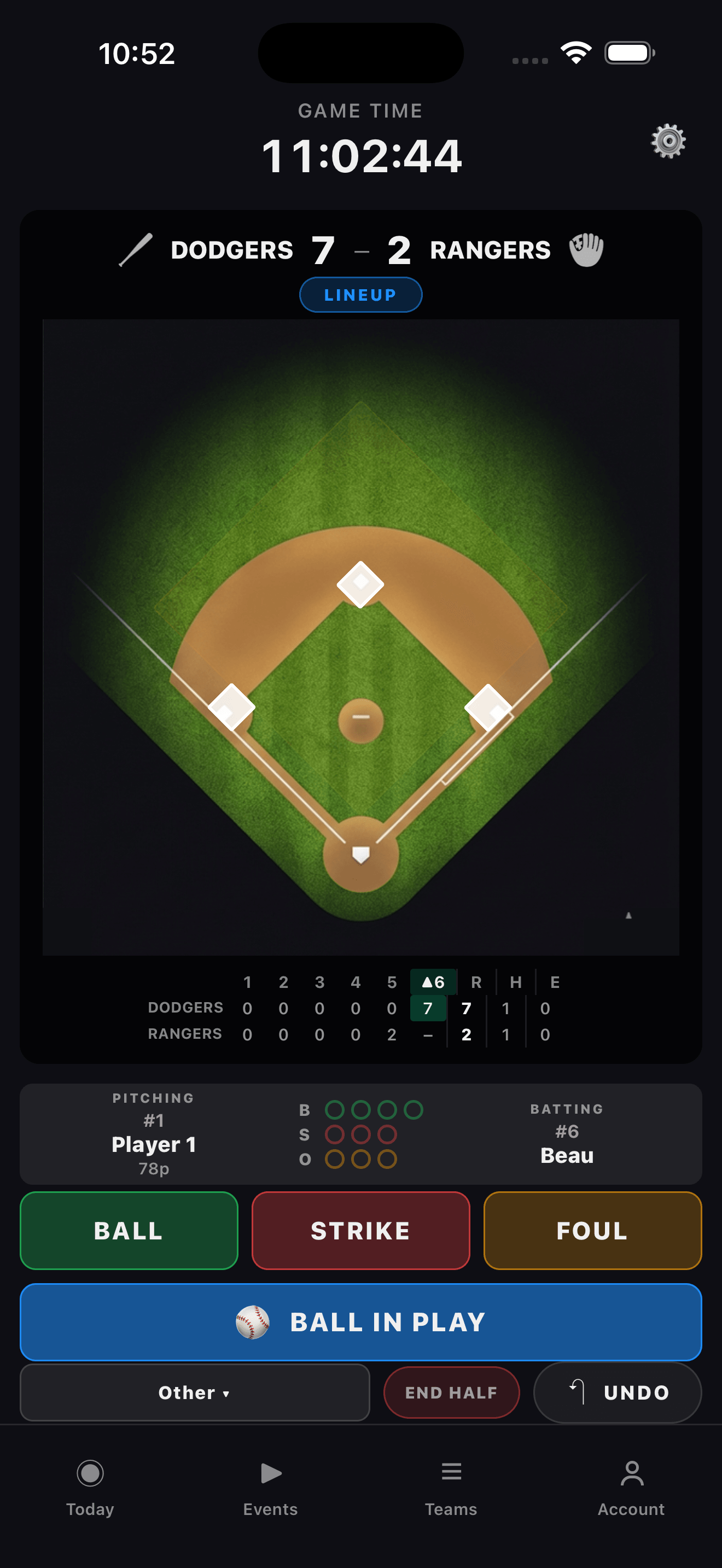
Keeping score on paper is a great way to learn the game, but when you're ready for something faster, Stathlon makes it easy to track stats, record highlights, and share box scores from your phone. No clipboard required — just tap and watch the stats build themselves in real time.
Ready to put this into practice?
Stathlon lets you score flag football games with a tap — touchdowns, PAT choices, safeties, and full quarter tracking. All from your phone.
Continue Reading
How to Score a Baseball Game: A Beginner's Guide
A practical guide for first-time baseball scorekeepers. What to track, how innings work, and how to record runs, hits, errors, and outs without getting lost.
The 7 Ways to Get on Base in Baseball
There are exactly 7 ways a batter can reach base in baseball. Most fans only know 2 or 3. Here's the complete list, from the obvious to the obscure.
Understanding Baseball Pitch Counts and Rest Rules
A parent-friendly guide to Little League pitch count limits by age, mandatory rest days, and why these rules exist. Includes the official thresholds for ages 6-16.