Flag Football Positions & Roles Explained
A beginner's guide to flag football positions — quarterback, receivers, center, rushers, and defenders. What each role does and how it affects scoring and stats.
How Flag Football Positions Differ from Tackle
Flag football uses fewer players (typically 5v5 or 7v7 vs. 11v11 in tackle), which means every player touches the ball more often and positions are more fluid. There are no offensive or defensive linemen — everyone is eligible to catch a pass, and defensive players pull flags instead of tackling.
This makes flag football uniquely good for developing all-around athletes. A kid who plays QB one drive might line up as a receiver the next.
Offensive Positions
Quarterback (QB)
The QB takes the snap and either throws or runs. In youth flag football, the QB is often the most experienced player because reading the defense and making accurate throws under pressure is the hardest skill on the field.
Stats to watch: Pass attempts, completions, completion percentage, passing touchdowns, interceptions thrown.
Center (C)
The center snaps the ball to the QB. In flag football, the center is usually eligible to receive a pass after the snap (unlike tackle football where the center is an ineligible lineman). Some leagues require a direct snap; others allow a shotgun snap.
Stats to watch: Receptions (if they run routes after snapping).
Receivers (WR)
Receivers run routes and catch passes. In 5v5 flag football, there are typically 3 receivers plus the center and QB. In 7v7, there may be 4-5 receivers.
Stats to watch: Receptions, receiving touchdowns.
Running Back (RB)
Some formations use a running back who takes a handoff or pitch from the QB. In flag football, rushing is often less common than passing because the defense can blitz freely, making handoffs risky.
Stats to watch: Rushing touchdowns. (Stathlon doesn't track rushing yards — see What to Track for why.)
Defensive Positions
Defensive Backs (DB / Safety / Corner)
Every defensive player in flag football is essentially a defensive back — they cover receivers and pull flags. There are no defensive linemen in most flag leagues.
Stats to watch: Interceptions, defensive touchdowns (pick-6 returns).
Rusher
Most flag football leagues designate one player as the rusher — they can cross the line of scrimmage and go after the QB after a set count (typically 4-7 seconds). The rusher must start 7 yards behind the line of scrimmage.
Stats to watch: Rushers don't accumulate individual stats in most scoring systems, but their pressure affects the QB's completion percentage.
How Positions Affect Scorekeeping
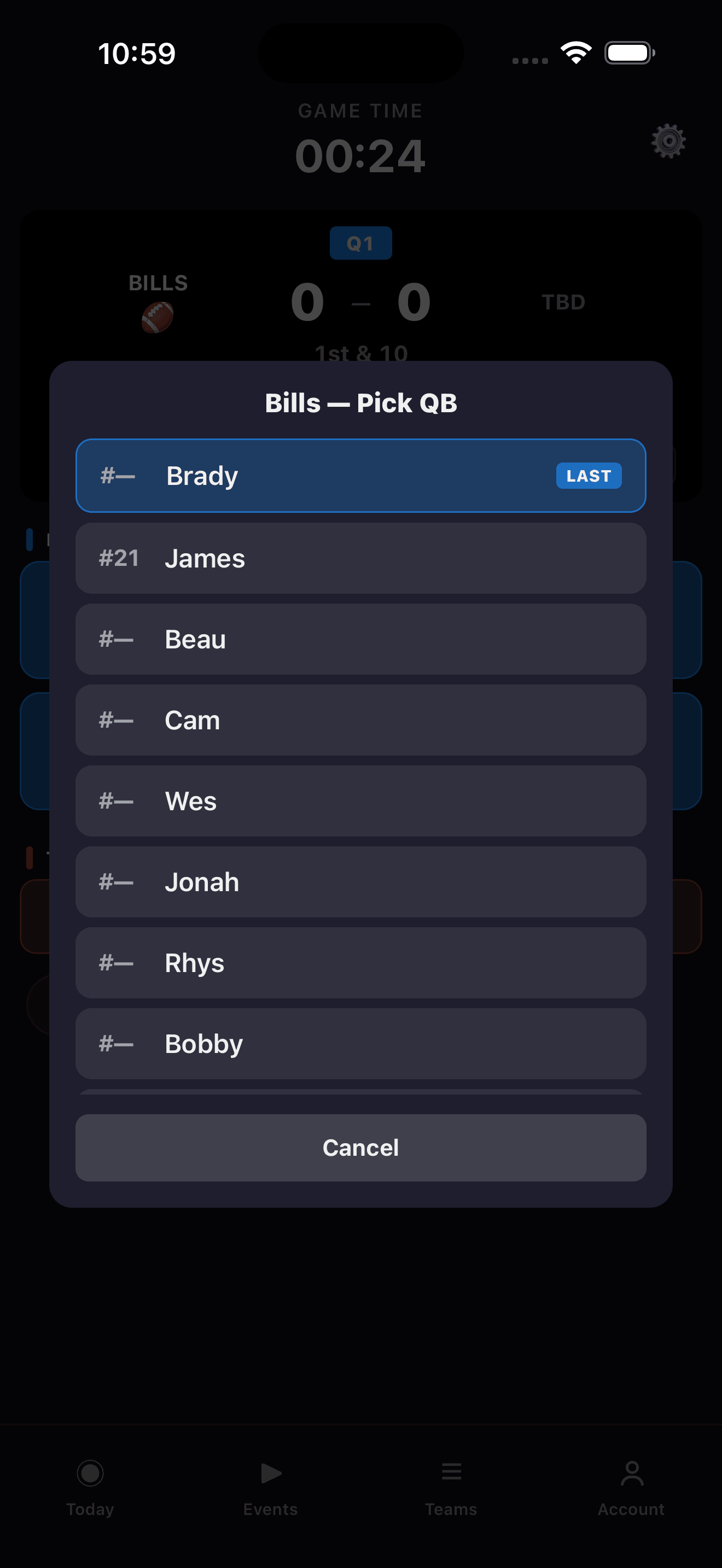
When you're scoring a flag football game with Stathlon, you don't need to track positions explicitly — the app attributes stats based on what the player did on each play, not what position they're listed as.
- If a player throws a pass, they get QB stats (attempts, completions, TDs)
- If a player catches a pass, they get receiver stats (receptions, receiving TDs)
- If a player runs for a TD, they get a rushing touchdown
- If a player intercepts a pass, they get a defensive interception
This means a player who plays QB on one drive and receiver on another gets stats in both categories — which is exactly how flag football works in practice.
Try Scoring a Game
See how player attribution works in practice with the interactive scoring demo. Every play credits the right player automatically.
Ready to put this into practice?
Stathlon lets you score flag football games with a tap — touchdowns, PAT choices, safeties, and full quarter tracking. All from your phone.
Continue Reading
Flag Football Player Stats — What to Track
A parent and coach's guide to tracking individual player stats in flag football. Learn which stats matter, how they're recorded, and how Stathlon automates the box score.
Flag Football Scoring Rules
How scoring works in flag football — touchdowns, extra point attempts, safeties, and the key differences from tackle football.
How to Keep Score at a Flag Football Game
A practical, step-by-step guide for first-time flag football scorekeepers. Pre-game prep, during the game, the PAT moment, and what to do between quarters.