How to Keep Score at a Flag Football Game
A practical, step-by-step guide for first-time flag football scorekeepers. Pre-game prep, during the game, the PAT moment, and what to do between quarters.
You Got Volunteered. Now What?
Someone handed you a clipboard (or a phone with Stathlon open) and said, "Can you keep score?" Maybe your kid is playing. Maybe you're helping at a rec league. Maybe you drew the short straw at the parent meeting. Whatever brought you here, this guide will walk you through everything you need to do — from before the first snap to after the final whistle.
The good news: flag football scorekeeping is straightforward. There are fewer scoring events than tackle football, the pace is manageable once you know what to watch for, and the margin for error is small because most scoring plays are obvious. Let's get you ready.
Before the Game: Your Pre-Game Checklist
The five minutes before the game starts are the most important five minutes of your scorekeeping day. Get these things sorted and the rest will flow.
1. Confirm the game format
Ask the head referee or league coordinator:
- How long are the quarters? (Usually 8-12 minutes)
- What kind of clock? (Running, stop, or hybrid — this tells you how fast the game will move)
- Overtime rules? (Alternating possessions? Ties allowed? You need to know this before it matters.)
For a detailed breakdown of game formats, see our Flag Football Game Structure guide.
2. Get the team names
This sounds basic, but in youth flag football, teams are sometimes identified by color ("Blue vs. Red") and other times by name ("Sharks vs. Eagles"). Confirm what you should use on the score sheet. If teams have a home/away designation, note which is which.
3. Know the PAT rules
The extra point attempt after a touchdown is the single most important moment for a scorekeeper. Ask:
- What's the +1 distance? (Typically 5 yards)
- What's the +2 distance? (Typically 10-12 yards)
These distances tell you where the ball will be placed after a touchdown. Knowing this helps you recognize what's happening in real time.
4. Know the timeout allocation
How many timeouts per team per half? This varies by league (usually 1-3). Write the allocation at the top of your score sheet so you can track them by marking each one as it's called.
5. Set up your score sheet
Whether you're using paper or an app, start with:
- Both team names
- "Quarter 1" marked and ready
- Starting score: 0-0
- Timeout tracking areas for each team
That's it. You're ready.
During the Game: What to Watch For
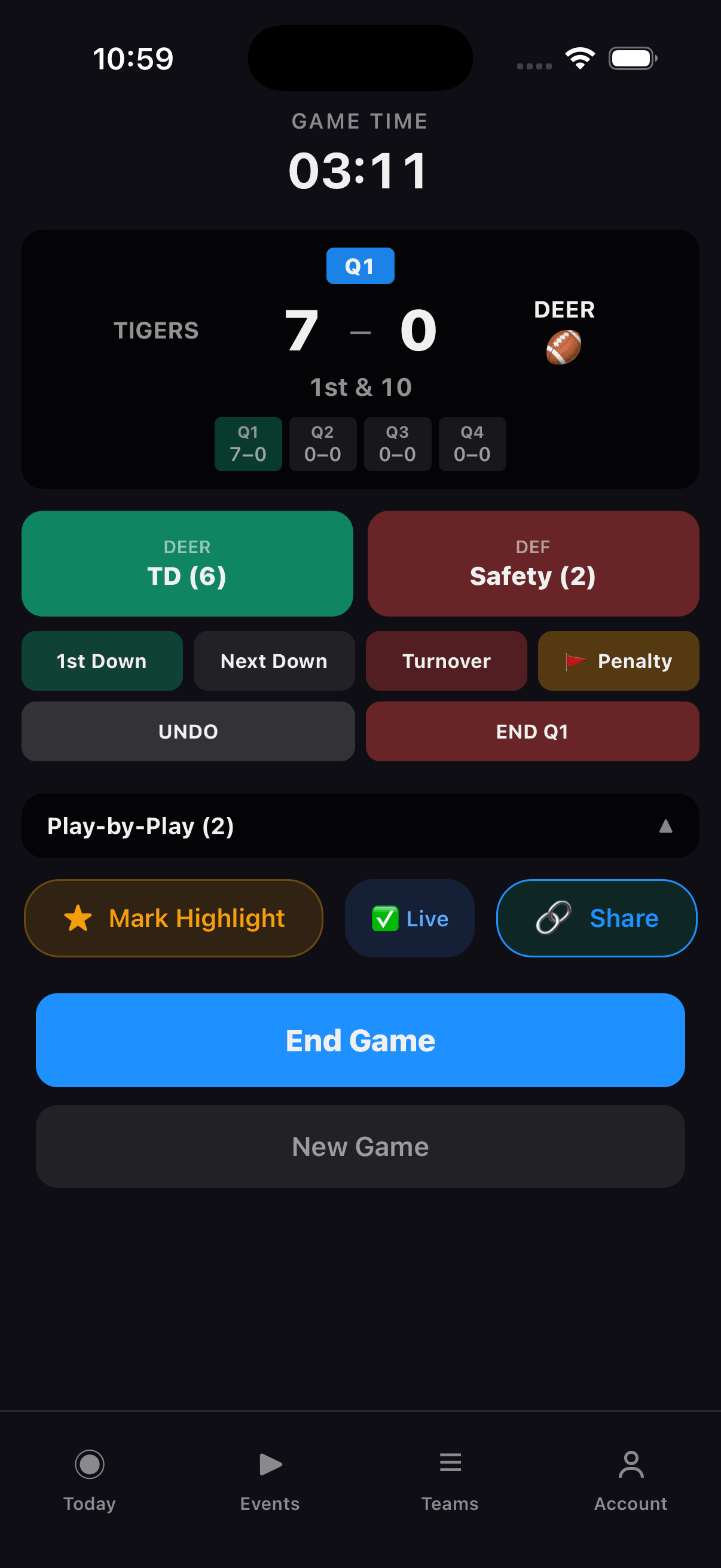
Once the game starts, your primary focus is simple: watch for the ball to cross the goal line. That's a touchdown. Everything else on the field — first downs, penalties, big plays — is interesting but doesn't change the score.
Touchdowns (6 points)
When a player catches or runs the ball into the end zone, that's a touchdown. The referee will signal it with both arms raised straight overhead. Record:
- Which team scored (this should be obvious — it's the team on offense)
- 6 points added to their score
- The quarter it happened in
Then immediately shift to the most important moment of your job.
The PAT Moment: Do Not Look Away
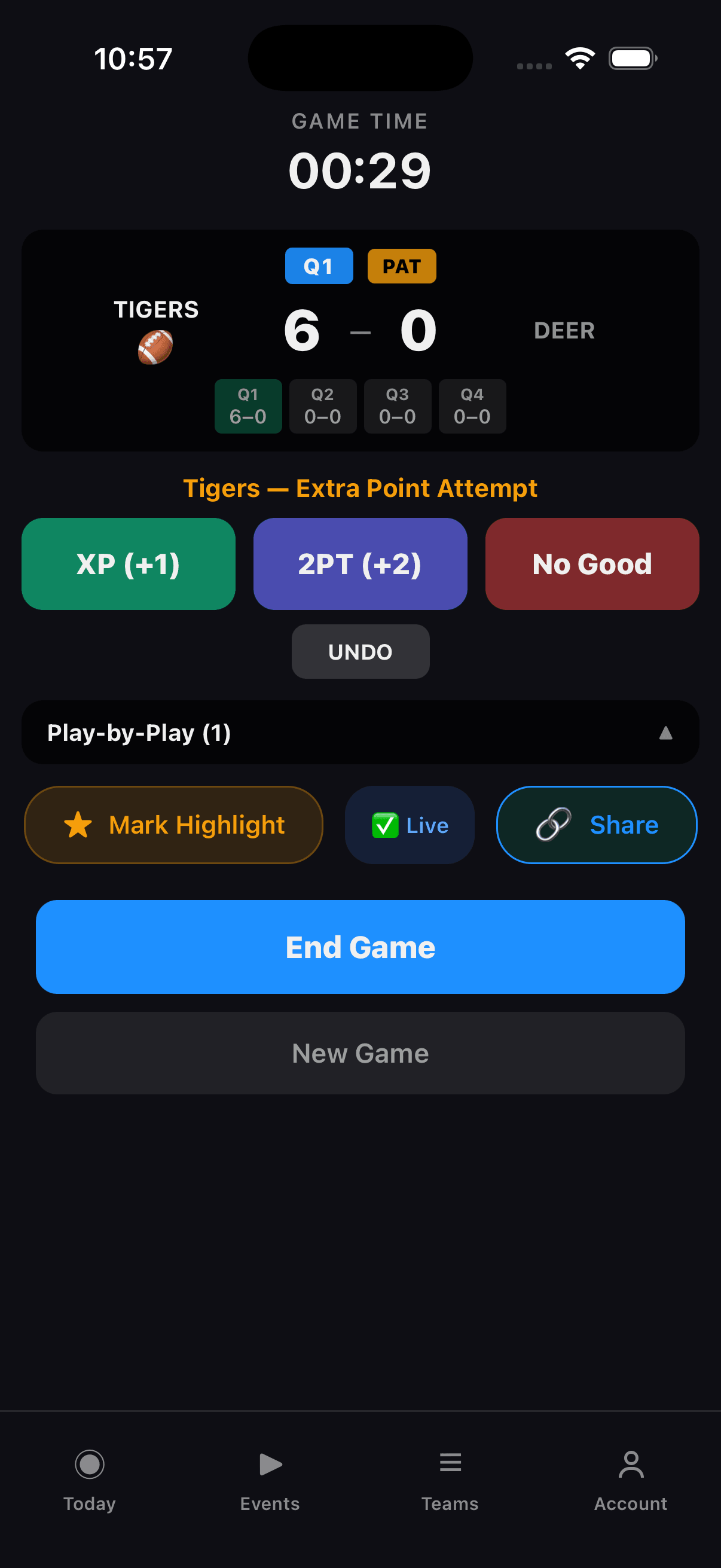
After every touchdown, the scoring team attempts a conversion play. This is the +1 or +2 attempt, and it is the single most common place scorekeepers make mistakes.
Here's what happens:
- The scoring team chooses +1 (short distance) or +2 (longer distance)
- The ref spots the ball at the appropriate yard line
- The team runs a play
- The play either succeeds (points awarded) or fails (no additional points)
You MUST record the result of the PAT before moving on. Not after the next play. Not at the end of the quarter. Right now. The three possible outcomes:
| Result | Points | Total with TD |
|---|---|---|
| +1 Good | 1 | 7 |
| +2 Good | 2 | 8 |
| No Good (failed) | 0 | 6 |
The reason this matters so much is that the difference between a 7-point and a 6-point score might decide the game. If you forget to record the PAT and try to reconstruct it later, you'll often get it wrong — especially in fast-paced youth games where multiple TDs can happen in quick succession.
Practical tip: If you're using a paper score sheet, draw a circle after each TD and write "+1", "+2", or "NG" inside it immediately. Don't wait. If you're using Stathlon, the app won't let you continue until you record the PAT result — it's designed to prevent exactly this mistake.
For the complete breakdown of scoring plays and point values, see our Flag Football Scoring Rules.
Safeties (2 points — rare)
A safety happens when the offense is flagged in their own end zone. The defensive team gets 2 points. Safeties are rare in flag football — you might go an entire season without seeing one. But if it happens, remember: the points go to the team that was NOT on offense.
Turnovers and possession changes
Turnovers (interceptions, turnover on downs) don't change the score, but noting when possession changes helps you stay oriented. If you know which team has the ball, you know which team to credit if a quick touchdown follows.
Between Quarters
When a quarter ends, take 30 seconds to do a quick check:
- Update the quarter on your score sheet
- Verify the running score — does it match what you've been recording play-by-play?
- Check timeout counts — do you agree with the refs on how many each team has left?
- Breathe — you're doing great
Halftime
Halftime is your reset. Use it to:
- Double-check your math. Add up the scoring plays and make sure they match your running total. If something doesn't add up, figure out why now — not at the end of the game.
- Reset timeout counts if your league resets at half (most do).
- Confirm any rule clarifications. If anything confused you in the first half, ask the ref during the break. They'd rather answer now than deal with a scoring dispute later.
The Final 2 Minutes
Many leagues switch to a stop clock in the final 2 minutes of each half. The game slows down, and scoring plays may become more consequential. A few things to be aware of:
- Coaches may call more timeouts. Track them carefully — a disputed timeout in the final minute is a headache nobody wants.
- PAT choices become strategic. A team down by 7 that scores a TD might go for +2 to take the lead. A team up by 1 might go for +2 to extend the cushion. Pay attention to the choice.
- Overtime might be coming. If the score is close in the 4th quarter, review the overtime rules so you're ready.
After the Game
When the final whistle blows:
- Record the final score. Both teams, all four quarters, and the total.
- Confirm with the refs. Walk over and verify your final score matches theirs. If there's a discrepancy, sort it out while the game is fresh in everyone's memory.
- Report the score. Your league will have a process — a website, a text to the coordinator, a form. Do it promptly.
- Keep your score sheet. Hold onto it for at least a week in case questions come up.
The Cheat Sheet
Tape this to the back of your clipboard:
| Event | Record | Points |
|---|---|---|
| Touchdown | Team + quarter | +6 |
| PAT +1 Good | Immediately after TD | +1 |
| PAT +2 Good | Immediately after TD | +2 |
| PAT No Good | Immediately after TD | +0 |
| Safety | Defense gets points + quarter | +2 (to defense) |
| Timeout | Team + quarter | No points |
| Quarter change | Update quarter number | No points |
You've Got This
Flag football scorekeeping comes down to three things: watch for touchdowns, record the PAT immediately, and track the quarter. Everything else is secondary. The game moves fast, but the scoring events are clear and well-signaled by the refs.
Your first game might feel hectic. By the third game, it'll feel routine. And your team's coach, your kid's league, or whoever asked you to help will genuinely appreciate that someone was paying attention to the scoreboard.
One last thing — if you make a mistake, fix it. Talk to the refs between plays, correct the score, and move on. Nobody expects perfection from a volunteer scorekeeper. They just expect someone who cares enough to try.
Now go keep score.
Ready to put this into practice?
Stathlon lets you score flag football games with a tap — touchdowns, PAT choices, safeties, and full quarter tracking. All from your phone.
Continue Reading
Flag Football Player Stats — What to Track
A parent and coach's guide to tracking individual player stats in flag football. Learn which stats matter, how they're recorded, and how Stathlon automates the box score.
Flag Football Positions & Roles Explained
A beginner's guide to flag football positions — quarterback, receivers, center, rushers, and defenders. What each role does and how it affects scoring and stats.
Flag Football Scoring Rules
How scoring works in flag football — touchdowns, extra point attempts, safeties, and the key differences from tackle football.