Volleyball Set & Match Structure
How volleyball matches are structured — best-of-3 vs best-of-5, deciding set rules, timeouts, substitutions, and what happens between sets.
The Big Picture: Sets and Matches
A volleyball match is made up of sets (sometimes called games). A team wins the match by winning a majority of the sets. The two standard formats are best-of-3 and best-of-5, and which one you'll encounter depends on the level of play.
Understanding the match structure is essential for scorekeeping. You need to know how many sets could be played, when a set ends, and what special rules apply to the deciding set. Let's break it all down.
Best-of-3 vs Best-of-5
Best-of-3
In a best-of-3 match, the first team to win 2 sets wins the match. A match can last 2 sets (if one team wins both) or 3 sets (if teams split the first two).
Best-of-3 is the standard format for:
- Youth and recreational leagues
- Middle school and most high school matches
- Many adult recreational leagues
- Pool play in tournaments (the early rounds before elimination brackets)
Best-of-5
In a best-of-5 match, the first team to win 3 sets wins the match. A match can last anywhere from 3 sets (a sweep) to 5 sets (if teams keep trading wins).
Best-of-5 is used at:
- Varsity high school (varies by state)
- College (NCAA)
- Professional and international play
- Elimination rounds in tournaments (semifinals, finals)
If you're scorekeeping at a rec league, you'll almost always be working a best-of-3 match. But it's worth knowing both formats — tournament finals sometimes switch to best-of-5 even in youth leagues.
Regular Sets: Played to 25
The first four sets of any match (Sets 1-4) follow the same rules:
- Played to 25 points
- Must win by 2 points
- No point cap — if the score reaches 24-24, play continues until one team leads by 2 (26-24, 27-25, 28-26, and so on)
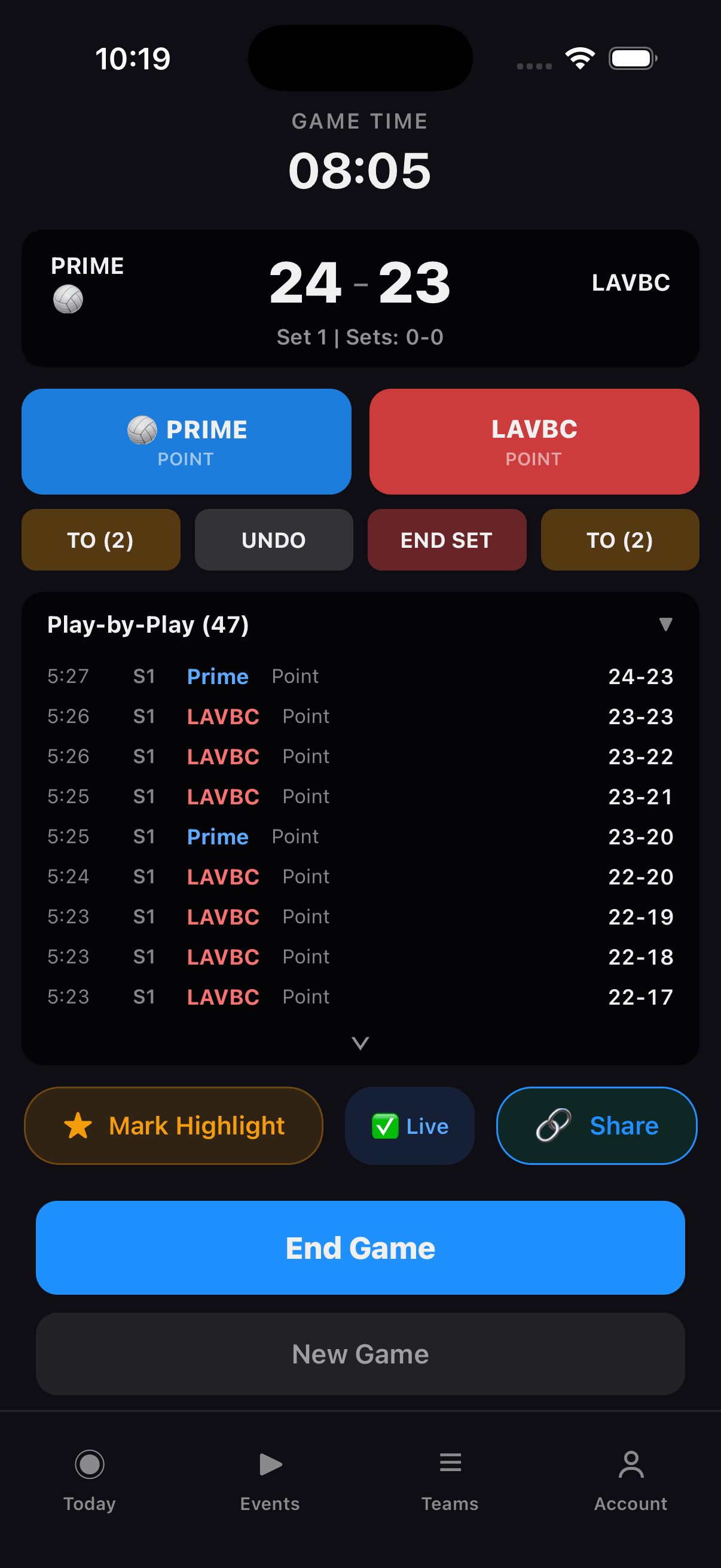
Most rec league sets take 20-30 minutes, depending on how competitive the teams are. Lopsided sets can be over in 15 minutes; tight ones can stretch past 30.
When a Set Ends
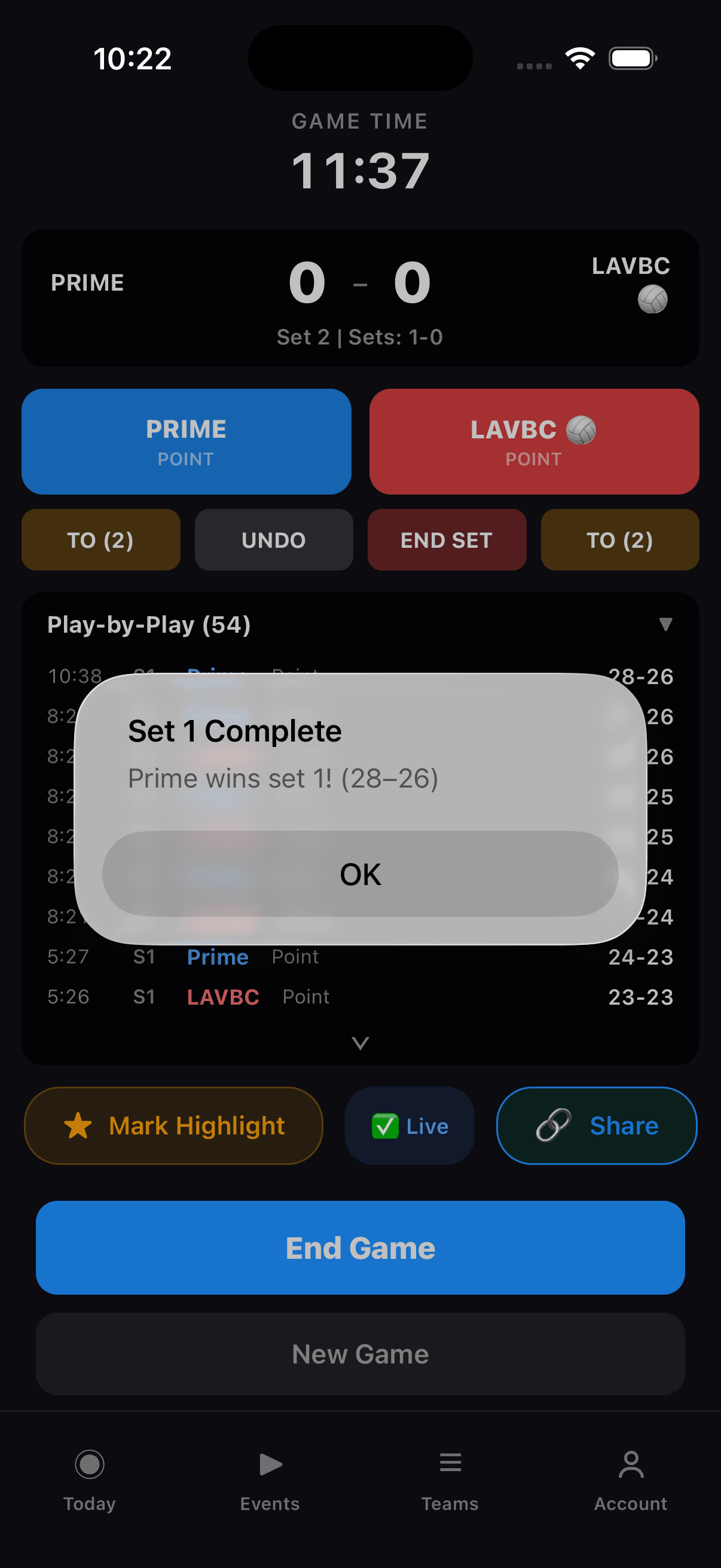
A set ends the moment a team reaches 25 points (or 15 in the deciding set) and leads by at least 2. In Stathlon, the app detects this automatically and shows a "Set Complete" alert with the final score. Tap OK and the next set starts fresh at 0-0.
The Deciding Set: Different Rules
The final possible set in a match — Set 3 in best-of-3 or Set 5 in best-of-5 — is called the deciding set, and it has two important differences.
Played to 15 (not 25)
The deciding set is only played to 15 points, still with the win-by-2 requirement. This makes it shorter and higher-pressure — every point carries more weight.
Teams Switch Sides at 8
In the deciding set, teams switch sides of the court when the leading team reaches 8 points. This is meant to equalize any advantage from court conditions — sun, wind in outdoor play, or crowd proximity indoors.
Play pauses briefly for the switch. Players walk to the other side, and the team that was serving before the switch continues serving from the same position in the rotation. As a scorekeeper, you don't need to do anything special during the switch — just note the score and continue tracking.
The side switch only happens in the deciding set. In Sets 1 through 4, teams stay on their assigned side for the entire set.
Starting a New Set
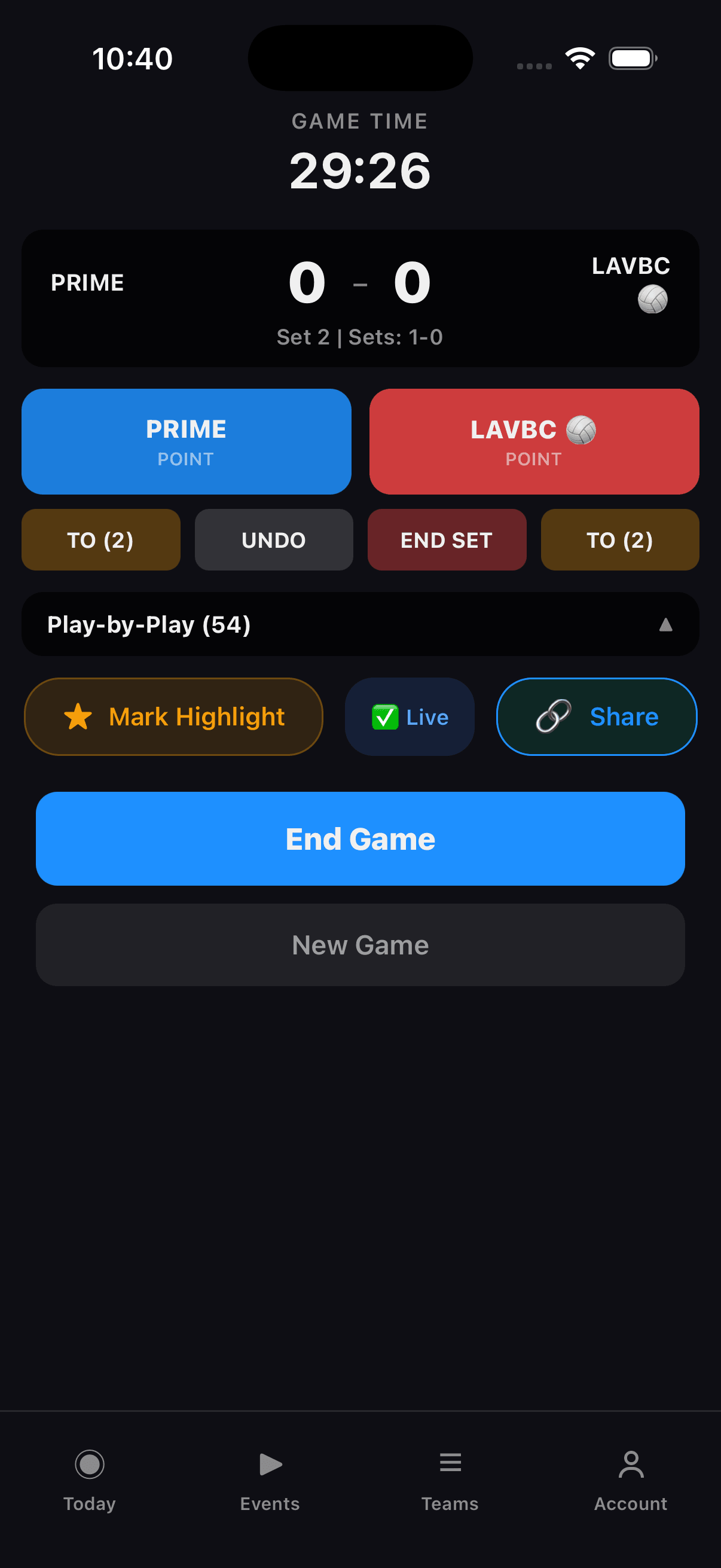
When a new set starts, scores reset to 0-0 but the set counter updates. The app tracks how many sets each team has won so you always know how close the match is to ending.
Timeouts
Each team gets a set number of timeouts per set. The exact number depends on the governing body:
| Level | Timeouts per Set | Duration |
|---|---|---|
| FIVB (international) | 2 | 30 seconds |
| NCAA (college) | 2 | 75 seconds (media) |
| NFHS (high school) | 2 | 60 seconds |
| Rec leagues | Usually 2 | 30-60 seconds |
Key details for scorekeepers:
- Timeouts do not carry over. Unused timeouts from Set 1 are gone when Set 2 starts. Each set resets the count.
- Track them on your scoresheet. Most scoresheets have boxes to mark when each team uses a timeout. Record the score at the time of the timeout.
- Either team can call a timeout when the ball is dead (between rallies). A team cannot call a timeout during a rally.
Some leagues also use technical timeouts — automatic stoppages when a team reaches 8 and 16 points. These are more common in professional play and unlikely at rec leagues, but check your league rules.
Substitutions
Substitution rules vary more than almost anything else in volleyball. Here's the standard:
| Level | Substitutions per Set |
|---|---|
| FIVB | 6 |
| NCAA | 15 |
| High school | Varies by state (commonly 12-18) |
| Rec leagues | Often unlimited |
A substitution is a swap: one player comes in, one goes out. In formal rules, there's a restriction — a starter can only be replaced by one specific substitute, and that substitute can only be replaced by the original starter. This is called the one-for-one rule.
At rec leagues, this rule is often relaxed. Many rec leagues use free substitution, letting coaches swap anyone in and out as they please.
As a scorekeeper, your job is to record each substitution — the jersey number coming in, the jersey number going out, and the score at the time. This matters because if the count is disputed later, your sheet is the record.
The libero is a special case — libero replacements are not counted as substitutions. If you're curious about how the libero works, check the Volleyball Positions & Roles guide.
What Happens Between Sets
When a set ends, here's the standard sequence:
- Teams switch sides. After every set, teams swap which side of the court they're on. (Exception: some rec leagues skip this to save time.)
- Break period. The standard break between sets is 3 minutes. Teams use this time to huddle, get water, and plan for the next set.
- New lineups. Each team submits a new starting lineup for the next set. They can change their rotation order from the previous set.
- Coin toss / choice. For Sets 2 and beyond, the team that didn't choose first in the previous set gets first choice of serve or side. (In practice at rec leagues, the referee usually just alternates who serves first.)
A Typical Rec League Match Timeline
Here's what a best-of-3 rec league match looks like from start to finish:
- Warmup: 5-10 minutes
- Set 1: 20-25 minutes (played to 25, win by 2)
- Break: 3 minutes, teams switch sides, new lineups
- Set 2: 20-25 minutes
- If needed — Break: 3 minutes, teams switch sides
- Set 3 (deciding): 15-20 minutes (played to 15, switch sides at 8, win by 2)
Total match time: roughly 60-90 minutes. As a scorekeeper, you'll be active the entire time — but the breaks give you a moment to double-check your sheet and reset for the next set.
Quick Reference
| Regular Set (1-4) | Deciding Set (3 or 5) | |
|---|---|---|
| Played to | 25 | 15 |
| Win by | 2 | 2 |
| Side switch | No | Yes, at 8 points |
| Timeouts | 2 per team | 2 per team |
| Subs | Reset each set | Reset each set |
What to Read Next
For more detail on how scoring works within each set:
- Volleyball Scoring Rules — point-by-point scoring, the win-by-2 rule, and what happens when sets go past 25
- Rally Scoring Explained — how the modern scoring system works and why volleyball switched to it
Ready to put this into practice?
Stathlon lets you score games, stream live video, and capture highlights — all from your phone. The scoring interface is designed so everything you just learned applies directly.
Continue Reading
Complete Guide to Volleyball Scoring
Everything you need to know about volleyball scoring — from rally scoring basics to win-by-two rules and set structure.
How to Keep Score at a Volleyball Game
A step-by-step guide for volunteer scorekeepers at volleyball games. What to bring, how to set up, what to do during the match, and how to handle the unexpected.
Rally Scoring Explained
How rally scoring works in volleyball, why it replaced side-out scoring, and what it means for scorekeepers.