Soccer Scoring Rules for Scorekeepers
A clear guide to soccer scoring rules: how goals work, own goals, halftime structure, stoppage time, and penalty shootouts. Written for first-time volunteer scorekeepers.
The Simplest Scoring in Sports
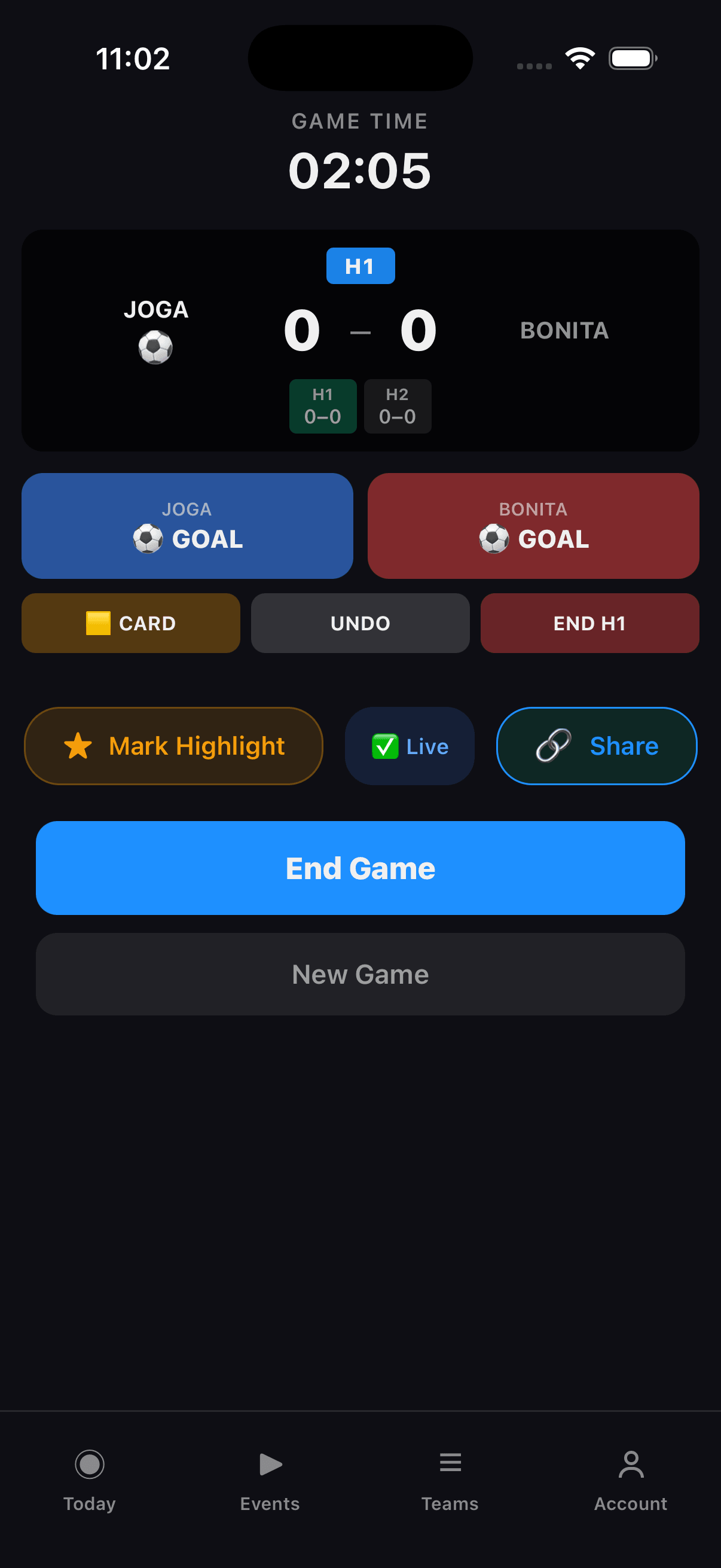
If you volunteered to keep score at a soccer game and you are nervous about it, take a breath. Soccer has the simplest scoring system in all of team sports. A goal is worth one point. That is the only way to score. There are no two-pointers, no bonus points, no extra points after a goal. One goal, one point, every time.
Your main job is to track which team scored and when. If you can do that, you are already a competent soccer scorekeeper.
What Counts as a Goal
A goal is scored when the entire ball crosses the goal line between the posts and under the crossbar. This is an important distinction: the ball does not just need to touch the line. Every part of the ball must be completely past the line.
In professional soccer, this is tracked by goal-line technology. At a youth rec game, the referee makes the call. As the scorekeeper, you do not decide whether something is a goal. You wait for the referee to signal, and then you record it.
Key points
- The ball must fully cross the goal line — not just touch it
- Only the referee's decision matters, not what you think you saw
- A goal can be scored with any body part except the hands and arms (unless you are the goalkeeper in your own box)
- A goal scored directly from a kickoff, corner kick, or free kick all count the same: one point
Own Goals
An own goal happens when a player accidentally puts the ball into their own team's net. Maybe a defender tries to clear the ball and deflects it past their own goalkeeper. Maybe a goalkeeper fumbles a save.
Here is what matters for the scorekeeper: an own goal counts as a goal for the attacking team. The team that was on offense gets the point, even though they did not technically kick the ball in. You record it the same way you would any other goal — one point for the attacking side.
If your scoresheet has a column for the scoring player, you can note "OG" or "own goal" instead of a player name. But the score itself is straightforward: the team that benefited gets the point.
The Structure of a Soccer Game
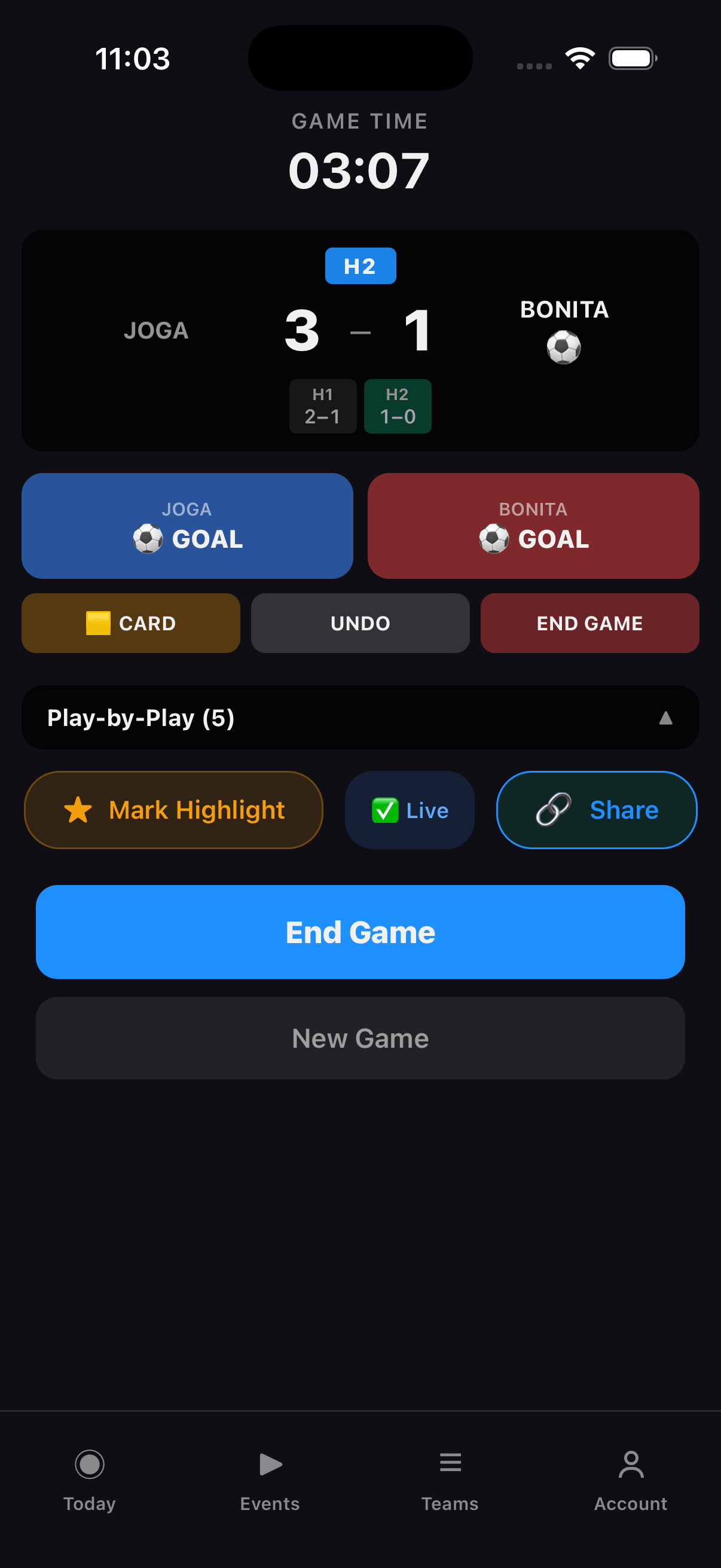
A soccer game is divided into two halves with a halftime break in between. The length of each half depends on the age group — at a youth rec league, halves can be anywhere from 10 minutes to 35 minutes. Adult games use 45-minute halves.
Your league coordinator or the referee will tell you the half length before the game starts. As a scorekeeper, you should confirm this during your pre-game check so you know when to expect halftime.
The halftime break
At halftime, teams switch sides of the field. This is a good time to double-check your scoresheet. Confirm the halftime score with the referee if you can. Note any goals or cards from the first half, and make sure your records match what the referee has.
The second half starts with a kickoff from the team that did not kick off the first half.
Stoppage Time (Added Time)
You may notice that the clock does not stop during a soccer game, even when play pauses for injuries, substitutions, or other delays. Instead, the referee keeps track of these stoppages and adds that time to the end of each half. This is called stoppage time or added time.
Here is the good news for scorekeepers: you do not need to track stoppage time. The referee handles it entirely. When the referee decides the half is over, the half is over. You just keep recording goals until they blow the final whistle.
If someone asks you "how much time is left," it is perfectly fine to say "that's up to the ref." Because it is.
Penalty Shootouts
Most youth rec league games do not go to penalty shootouts — ties are allowed, and everyone goes home. But if your league uses shootouts to break ties in a tournament or playoff, here is how to record them.
A penalty shootout happens after the game ends in a tie. Each team takes turns shooting from the penalty spot, one player at a time. In a standard shootout, each team gets five attempts.
How to record a shootout
The critical rule for scorekeepers: penalty shootout goals are recorded separately from the match score. The final match score stays as the tied result. The shootout is an add-on.
For example, if the game ends 2-2 and Team A wins the shootout 4-3, you would record:
- Match score: Team A 2, Team B 2
- Shootout: Team A 4, Team B 3
- Result: Team A wins 2-2 (4-3 on penalties)
Track each shootout attempt as either a goal or a miss/save. Go back and forth between teams — Team A shoots first, then Team B, then Team A, and so on. If one team builds an insurmountable lead (for example, they lead 3-0 after three rounds), the remaining kicks may be skipped. The referee will tell you when it is over.
Shootout vs. penalty kick during the game
Do not confuse a penalty shootout with a penalty kick awarded during regular play. A penalty kick during the game is just a special type of free kick — if it goes in, it counts as a regular goal in the match score. Only a post-game shootout gets recorded separately.
What You Do NOT Need to Track
Soccer scoring is refreshingly simple compared to sports like volleyball or football. Here is a list of things you do not need to worry about:
- Assists — nice to have, but not required for the official score
- Shots on goal — the referee or a separate stats keeper handles this
- Offsides — the referee and assistant referees call these; they do not affect your scoresheet
- Stoppage time — the referee adds it, you ignore it
- Corner kicks and throw-ins — these are just restarts, not scoring events
Your job is goals and the game clock (if your league asks you to run it). Everything else is optional.
Quick Reference
- Points per goal: 1 (always, no exceptions)
- Own goals: Count for the attacking team
- Ball must: Fully cross the goal line
- Game structure: Two equal halves with a halftime break
- Stoppage time: Referee handles it — not your job
- Penalty shootout: Recorded separately from the match score
- Simplest sport to score: Yes
For details on tracking cards and fouls during the game, see Yellow Cards, Red Cards & Fouls in Soccer.
Ready to put this into practice?
Stathlon lets you score soccer matches with a tap — goals, cards, halftime tracking, and full game summaries. All from your phone.
Continue Reading
How to Keep Score at a Soccer Game
A step-by-step guide for first-time volunteer scorekeepers at youth soccer games. Covers pre-game setup, tracking goals and cards, halftime, and post-game duties.
How to Track Soccer Stats for Youth Games
A practical guide to tracking soccer stats at youth games: goals, assists, cards, saves, and what volunteer scorekeepers should focus on. Plus tips for keeping it simple.
Youth Soccer Game Format — Halves, Periods & Match Length
How youth soccer games are structured: halves, match length by age group, overtime rules, and what scorekeepers need to track. From U6 through high school.