Complete Guide to Volleyball Scoring
Everything you need to know about volleyball scoring — from rally scoring basics to win-by-two rules and set structure.
How Volleyball Scoring Works
Modern volleyball uses rally scoring, which means a point is awarded on every single rally — regardless of which team served. The rally ends when the ball hits the floor, goes out of bounds, or a team commits a fault.
This is the scoring system used at every level of the sport today, from middle school rec leagues to the Olympics. If you're keeping score, every rally results in a point for one team.
Scoring to 25 (Win by 2)
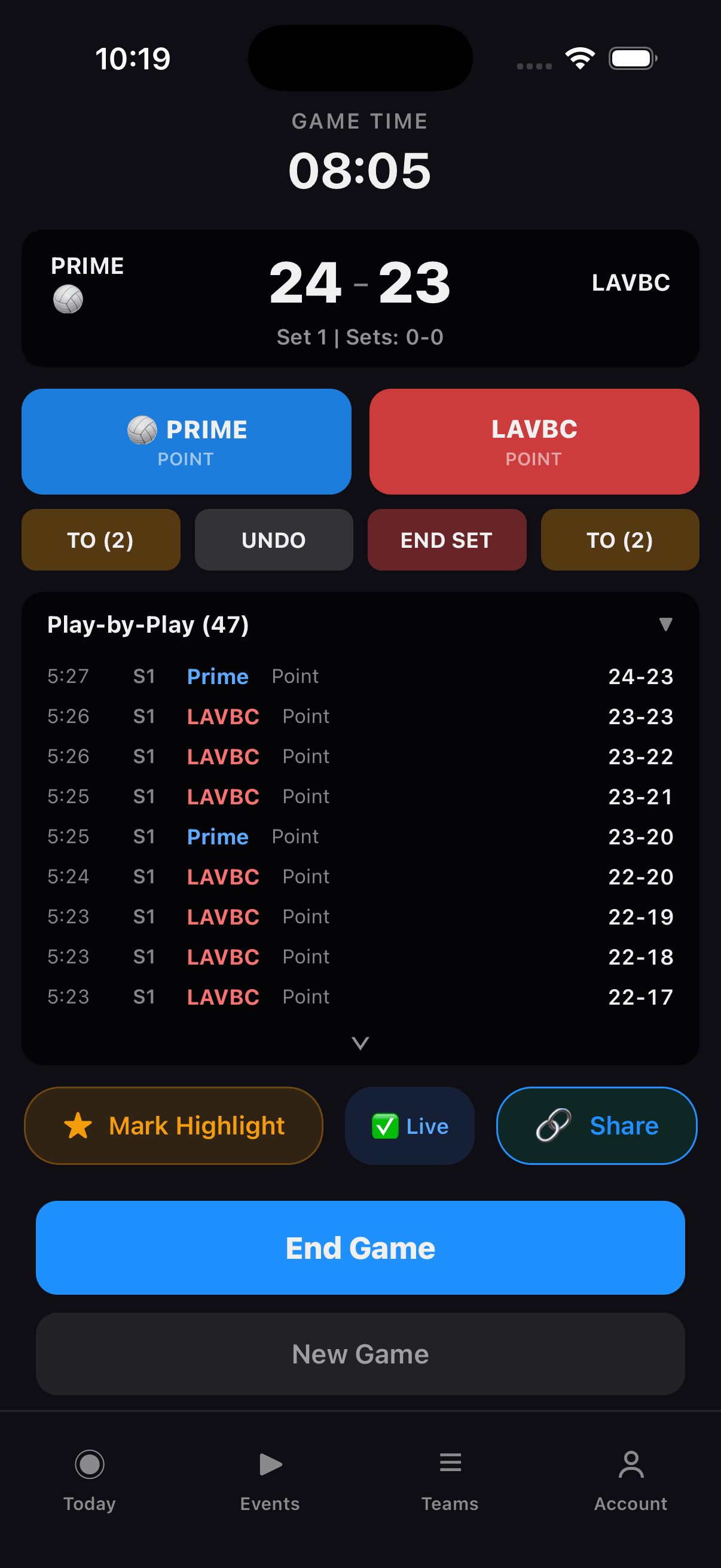
A standard volleyball set is played to 25 points. The catch: a team must win by at least 2 points. If the score reaches 24-24, play continues until one team leads by 2 (26-24, 27-25, 28-26, and so on).
There is no cap — a set can theoretically go on indefinitely until one team has a 2-point lead.
Key rules for scorekeepers
- Award one point per rally. No matter who served, the team that wins the rally gets the point.
- Track the score for both teams. The serving team's score is typically listed first on the scoreboard.
- Watch for 25. When a team reaches 25, check the margin. If they lead by 2 or more, the set is over. If not, play continues.
When sets go past 25
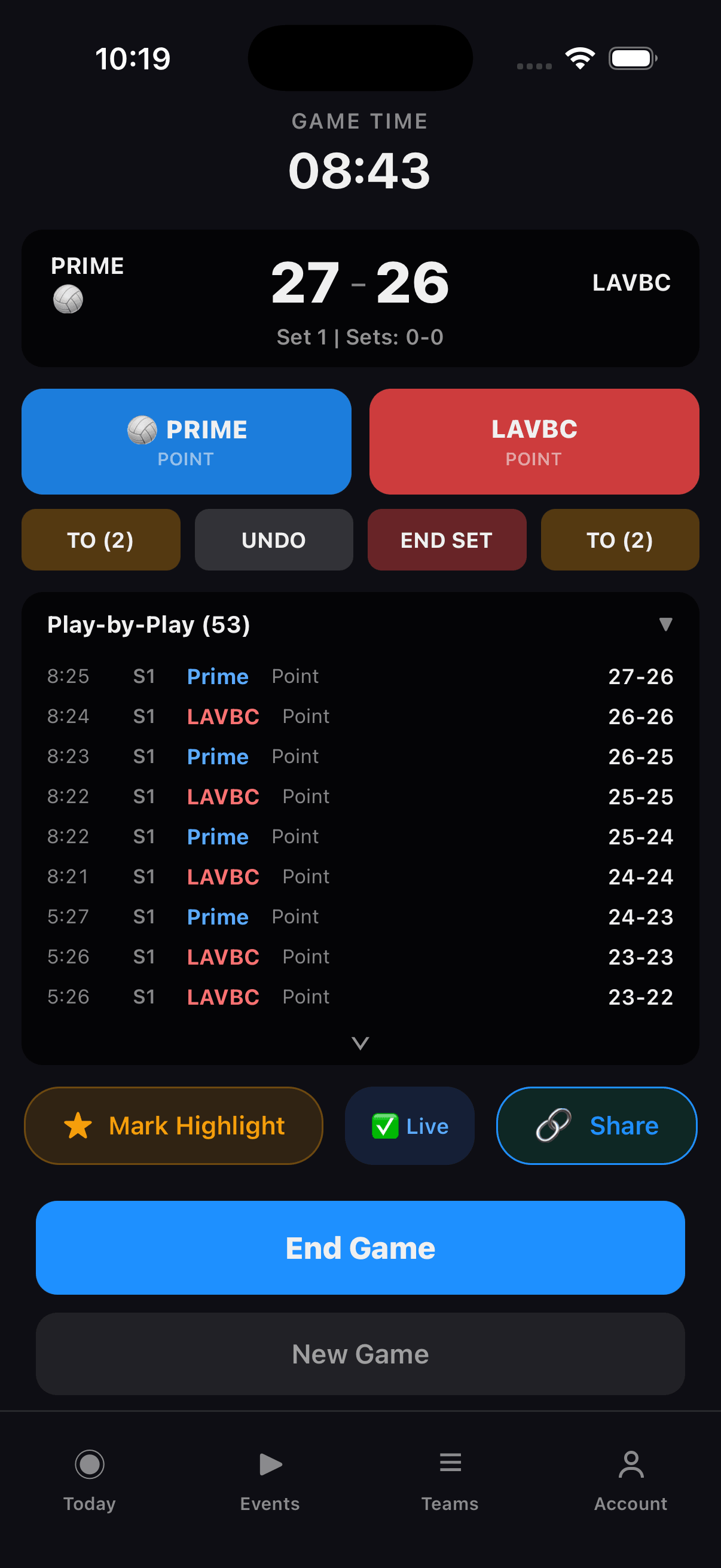
It's common for close sets to extend past 25. As a scorekeeper, there's nothing special you need to do — just keep recording points. The set ends automatically when one team has 25+ points and leads by 2.
The Deciding Set (Set 5 or Set 3)
If the match goes to a deciding set — the third set in a best-of-3 match or the fifth set in a best-of-5 match — the rules change slightly:
- The deciding set is played to 15 points (not 25)
- The win-by-2 rule still applies
- Teams switch sides when one team reaches 8 points
As a scorekeeper, the main thing to remember is the different target score. Everything else stays the same.
Match Formats
Volleyball matches come in two common formats:
| Format | Sets to Win | Common Level |
|---|---|---|
| Best of 3 | 2 | Recreation, youth, club practice |
| Best of 5 | 3 | High school varsity, college, pro |
Some tournaments use a single-set format (first to 25, win by 2) to keep games moving. Your league or tournament director will specify the format before the event.
Side-Out and Serving
When the receiving team wins a rally, it's called a side-out. The receiving team:
- Gets the point
- Gains the serve
- Rotates one position clockwise
This rotation is important for scorekeepers to track because it determines the serving order.
Common Scoring Situations
Here are the most common plays you'll score and how to handle them:
Ace
The server's ball lands in the opponent's court without being touched, or is touched but can't be returned. One point to the serving team. No rotation — the same server continues.
Kill
A player attacks the ball and it results in a point. One point to the attacking team. If the attacking team was receiving, they also rotate.
Service Error
The server hits the ball into the net, out of bounds, or commits a foot fault. One point to the receiving team. The receiving team rotates and takes over the serve.
Ball Handling Error
A player double-hits the ball, lifts it, or makes another illegal contact. One point to the other team.
Net Violation
A player touches the net during play, or reaches over the net illegally. One point to the other team.
Set Completion
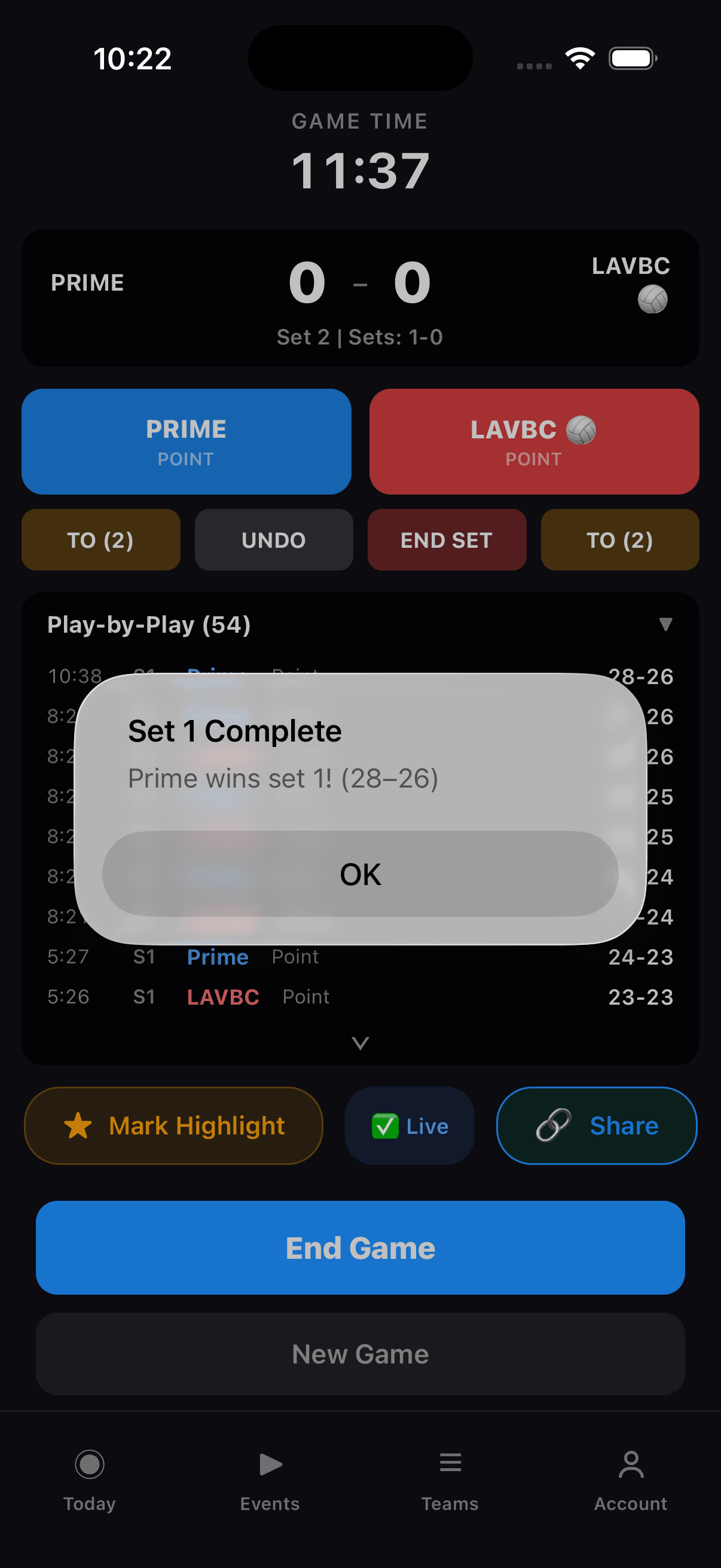
When a team wins a set, the scorekeeper records the final set score and resets for the next set. In Stathlon, this happens automatically — the app detects when the win-by-2 condition is met and prompts you to start the next set.
Scorekeeper Responsibilities
As a scorekeeper, your job during the match is to:
- Record the score after every rally — this is the core of the job
- Track which team is serving — important for rotation tracking
- Note timeouts — each team typically gets 2 per set
- Track substitutions — each team has a limited number per set
- Signal set completion — announce when a team has won the set
You don't need to identify what type of play occurred (ace, kill, error). You just need to know which team won the rally and give them the point.
Quick Reference
- Points per rally: 1 (always)
- Set target: 25 points (15 in deciding set)
- Win by: 2 points
- Best of 3: First to win 2 sets
- Best of 5: First to win 3 sets
- Side-out: Receiving team wins rally → gets point, serve, and rotates
For a deeper look at how rally scoring replaced the old side-out system, see Rally Scoring Explained.
Ready to put this into practice?
Stathlon lets you score games, stream live video, and capture highlights — all from your phone. The scoring interface is designed so everything you just learned applies directly.
Continue Reading
How to Keep Score at a Volleyball Game
A step-by-step guide for volunteer scorekeepers at volleyball games. What to bring, how to set up, what to do during the match, and how to handle the unexpected.
Rally Scoring Explained
How rally scoring works in volleyball, why it replaced side-out scoring, and what it means for scorekeepers.
Scorekeeping for Beginners — A Parent's Guide to Youth Sports
New to scorekeeping? A practical guide covering volleyball, flag football, and soccer. What to track, common mistakes, and how apps like Stathlon make it easier.