How to Keep Score at a Soccer Game
A step-by-step guide for first-time volunteer scorekeepers at youth soccer games. Covers pre-game setup, tracking goals and cards, halftime, and post-game duties.
You Can Do This
If someone just asked you to keep score at a youth soccer game and you have never done it before, here is the reassuring truth: soccer is the easiest sport to scorekeeper. There are no sets, no downs, no complicated point values. One team scores a goal, you add a point. That is the core of the job.
This guide walks you through exactly what to do before, during, and after the game. By the end, you will feel prepared — and you might even volunteer to do it again.
Before the Game
Arrive at least 10 minutes before kickoff. You have a short checklist to get through.
Get the team names
Ask the coaches or the referee for the official team names. Write them on your scoresheet. If you are using an app like Stathlon, enter them before the whistle blows. Getting this right up front saves confusion later.
Confirm the half length
This is important because half length varies dramatically by age group in youth soccer:
| Age Group | Half Length | Total Game Time |
|---|---|---|
| U6 | 10 minutes | 20 minutes |
| U8 | 15 minutes | 30 minutes |
| U10 | 25 minutes | 50 minutes |
| U12 | 30 minutes | 60 minutes |
| U14 | 35 minutes | 70 minutes |
| High School | 40 minutes | 80 minutes |
| Adult | 45 minutes | 90 minutes |
Ask the referee or check your league schedule. Do not assume — a U8 game is a completely different time commitment than a U14 game.
Note which team kicks off
The referee will conduct a coin toss to decide which team kicks off and which side each team defends. Note which team has the opening kickoff. The other team will kick off the second half.
Find your spot
Sit or stand where you can see the field clearly. Most scorekeepers set up at midfield on the same side as the team benches. You need a clear view of both goals.
During the First Half
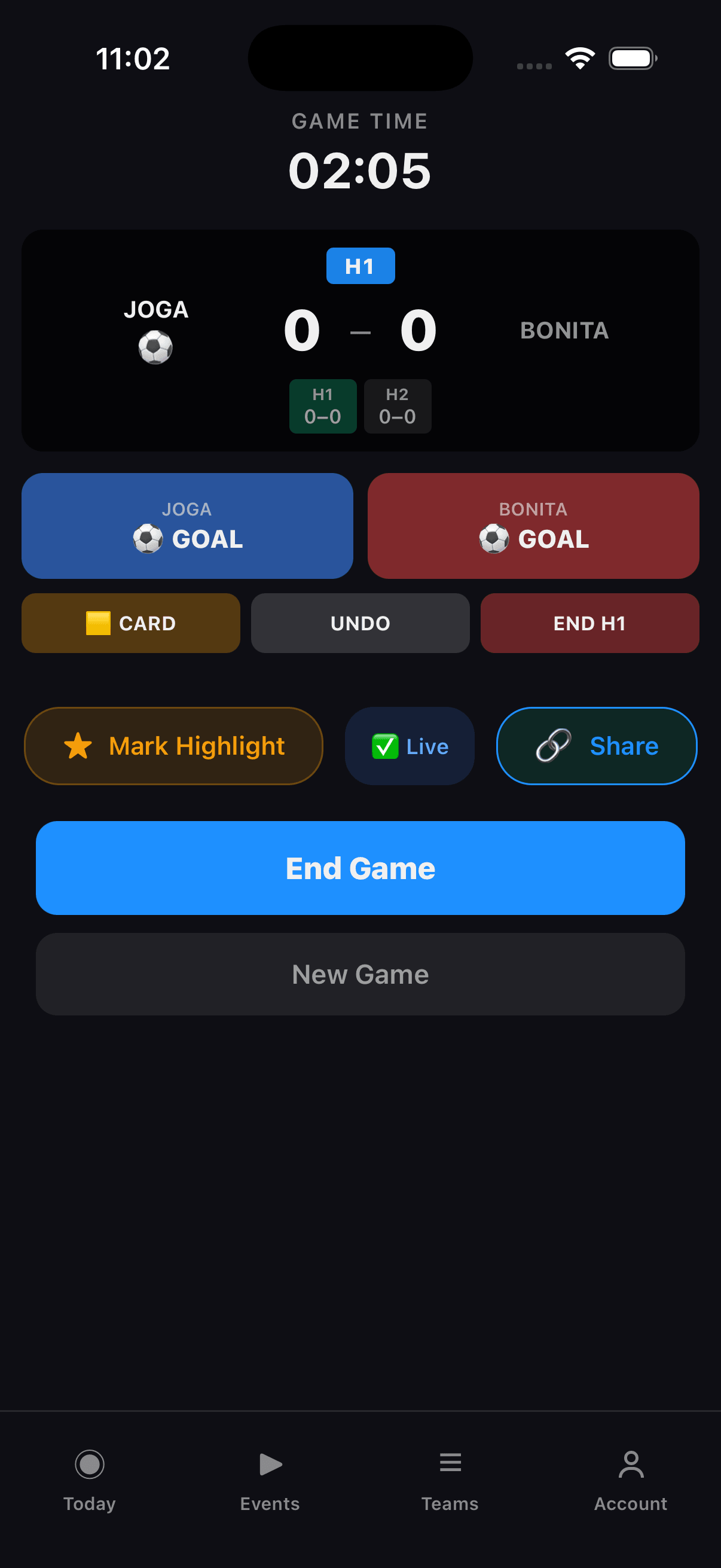
Once the whistle blows, your job is straightforward. Here is what to track.
Goals
When a goal is scored, record:
- Which team scored — this is the only essential piece
- The approximate minute — you do not need to be exact; "around the 12th minute" is fine
- The player who scored (if you can tell) — helpful but optional at the rec level
The referee will signal a goal by pointing to the center circle. Wait for that signal before recording anything. If you are not sure whether the ball crossed the line, trust the referee.
Do not worry about tracking assists, shots, or corner kicks unless your league specifically asks you to. For most rec leagues, goals are all that matter.
Cards (if your league asks you to track them)
If the referee shows a yellow or red card, note the player's number, their team, the approximate minute, and the card color. Not all leagues require the scorekeeper to track this — some have a separate official or leave it entirely to the referee. Ask before the game whether card tracking is part of your job.
For a detailed breakdown of cards and what they mean, see Yellow Cards, Red Cards & Fouls in Soccer.
The clock
Some leagues ask the scorekeeper to run the game clock. Others have the referee keep time, or use a separate timekeeper. Confirm your role before kickoff.
If you are running the clock: start it at kickoff, and do not stop it during play. The clock runs continuously in soccer, even during injuries or substitutions. The referee will add stoppage time at the end — that is their responsibility, not yours. Just run the clock straight through.
Substitutions
At the youth rec level, substitutions are often unlimited and happen frequently. You typically do not need to record every substitution. If your league does require it, the referee will signal subs at a stoppage in play, and you can note which players went in and out.
Halftime
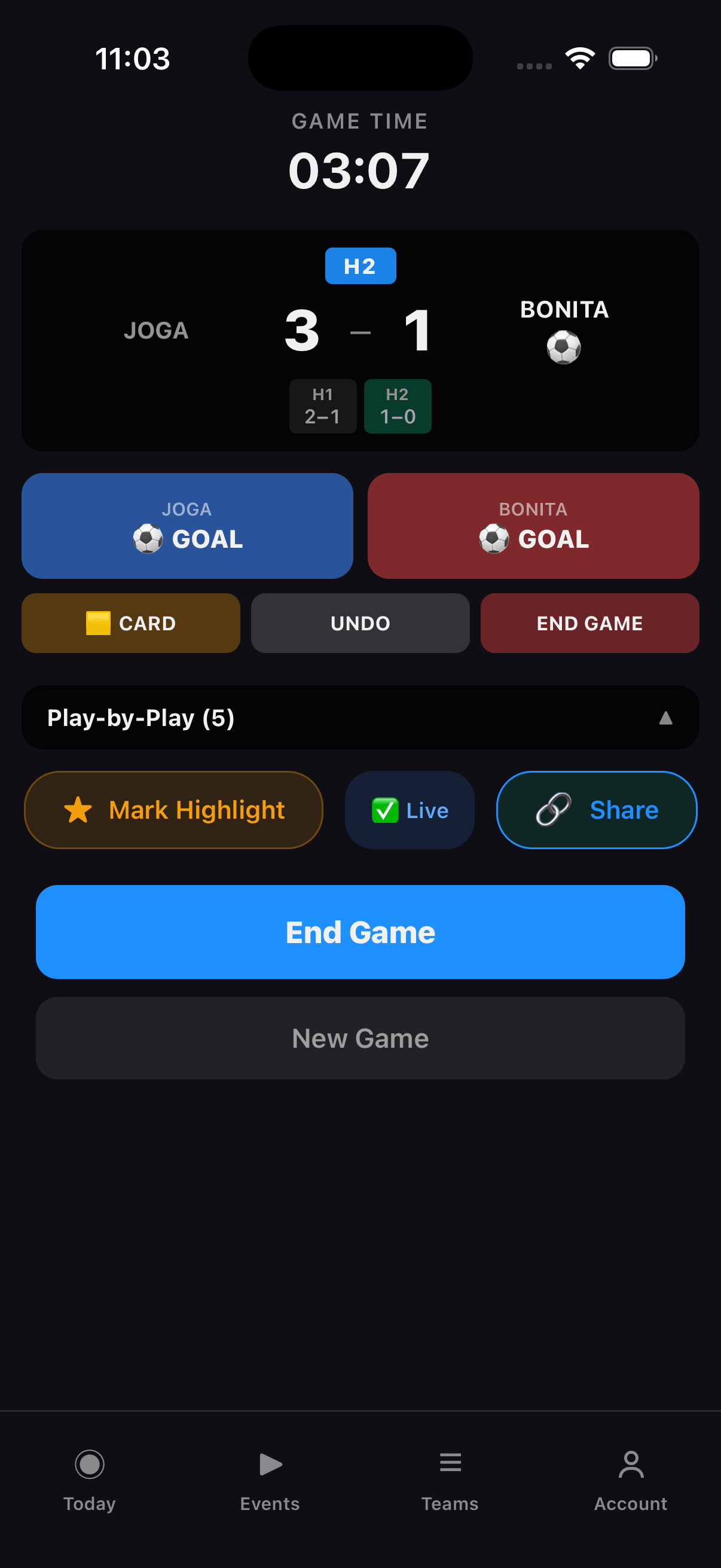
When the referee blows the whistle for halftime, you have a few things to take care of.
Record the halftime score
Write down the score at the half. This is useful for the game record and for coaches who want to reference it later. If you are using an app, it may track this automatically.
Review your notes
Quickly scan what you have written. Are the goal times reasonable? Did you miss anything? Halftime is your chance to clean up your records while the details are still fresh.
Note any first-half cards
If any cards were shown in the first half, confirm you have them recorded. This is especially important for yellow cards — if a player with a first-half yellow commits another cautionable foul in the second half, they will receive a red card and you want the record to be clear.
Confirm the score with the referee
If you can catch the referee during the break, a quick "I have it 2-1 Blue, does that match?" goes a long way. Referees appreciate a scorekeeper who double-checks.
During the Second Half
Everything works the same as the first half. The team that did not kick off the first half now kicks off. Teams switch sides of the field.
Keep recording goals and cards. The approximate minute continues from where the first half ended — so if halves are 25 minutes, the second half starts at the 25th minute. (Some leagues restart at 0:00 for each half. Either convention is fine as long as you are consistent.)
After the Game
When the referee blows the final whistle, your job is almost done.
Record the final score
Write down the final score. If you are keeping a paper scoresheet, circle it or put it in a prominent spot. This is the most important number on your entire sheet.
Report the score
Walk the completed scoresheet to the referee or the field marshal (whoever your league designates). Some leagues also want you to report the score to a tournament tent or league coordinator. Ask at the start of the day who needs the final score and how they want to receive it.
Note the result
For league standings, the result matters: win, loss, or draw. In youth rec soccer, ties are common and perfectly normal. There are no overtime periods or shootouts in most regular-season games (see Soccer Scoring Rules for how shootouts work in tournaments).
Why Soccer Is the Best Sport to Start With
If you are new to scorekeeping, soccer is a forgiving place to learn. Here is why:
- One type of score. A goal is a goal. No touchdowns, field goals, extra points, two-point conversions, or safeties. Just goals.
- Low scoring. Youth soccer games often end 1-0, 2-1, or 3-2. You might only need to record a handful of events all game.
- Continuous play. There are no timeouts, no end-of-quarter resets, no side changes every few minutes. The game flows, and you flow with it.
- The referee runs the show. In soccer, the referee controls the clock, calls the fouls, and makes all the decisions. You are there to record, not to officiate.
- Mistakes are recoverable. If you miss a goal, someone will tell you. If your time is off by a minute, nobody will notice. The final score is what matters, and that is easy to confirm.
So relax, bring a pen, enjoy the game, and record the goals. You have got this.
Quick Reference
- Pre-game: Team names, half length, kickoff team, find your spot
- During play: Record goals (team + approximate minute), cards if asked
- Halftime: Record halftime score, review notes, confirm with ref
- After game: Record final score, report to ref or league coordinator
- Easiest sport to start with: Yes, by a wide margin
For the complete rules on how goals and scoring work, see Soccer Scoring Rules for Scorekeepers. For details on tracking disciplinary actions, see Yellow Cards, Red Cards & Fouls in Soccer.
Ready to put this into practice?
Stathlon lets you score soccer matches with a tap — goals, cards, halftime tracking, and full game summaries. All from your phone.
Continue Reading
How to Track Soccer Stats for Youth Games
A practical guide to tracking soccer stats at youth games: goals, assists, cards, saves, and what volunteer scorekeepers should focus on. Plus tips for keeping it simple.
Soccer Scoring Rules for Scorekeepers
A clear guide to soccer scoring rules: how goals work, own goals, halftime structure, stoppage time, and penalty shootouts. Written for first-time volunteer scorekeepers.
Youth Soccer Game Format — Halves, Periods & Match Length
How youth soccer games are structured: halves, match length by age group, overtime rules, and what scorekeepers need to track. From U6 through high school.