How to Keep Score at a Volleyball Game
A step-by-step guide for volunteer scorekeepers at volleyball games. What to bring, how to set up, what to do during the match, and how to handle the unexpected.
You Got This
Someone asked you to keep score at a volleyball game. Maybe it's your kid's rec league, maybe you volunteered, maybe you were the only parent who made eye contact with the coach at the wrong moment. However you got here, you're now the scorekeeper.
The good news: it's simpler than it looks. You're going to watch the referee, record who won each rally, and keep a running count. That's the core of the job. Everything else is details, and this guide covers all of them.
Before the Game: What to Bring
If you're using a paper scoresheet (the most common setup at rec leagues), bring:
- Two pens — one for primary use, one backup. Pencils work too, but pen is easier to read from a distance.
- The scoresheet — your league may provide one, or the ref will have extras. If you want to bring your own, search for "volleyball scoresheet PDF" and print one. Standard formats have columns for each set, spaces for team names, timeout boxes, and substitution logs.
- Something to write on — a clipboard makes a huge difference. Balancing a scoresheet on your knee while scribbling is not fun.
- Your phone — not for scrolling, but as a backup scoring tool. If the paper gets confusing, a simple tally on your phone can save you.
If you're using Stathlon or another scoring app on your phone or tablet, you just need the device and enough battery. But it's still worth having a pen and paper as backup — phones die, apps crash, and the game doesn't wait.
Pre-Game Setup (10 Minutes Before First Serve)
Arrive a few minutes early and do these four things:
1. Find the Scoring Table
At most venues, the scorer sits at a table on the sideline between the two teams, directly across from the referee stand. If there's no table, find a seat with a clear view of the ref. You need to see their hand signals after every rally.
2. Confirm the Format with the Referee
Walk up to the ref (or wait for the pre-game meeting) and ask:
- "Best of 3 or best of 5?" — This tells you how many sets it takes to win the match.
- "Standard rules?" — Sets to 25, deciding set to 15, win by 2. Most rec leagues use standard rules, but some tournaments modify these (sets to 21, no deciding set, etc.).
- "Anything special I should know?" — Let the ref know you're a volunteer. They'll appreciate it, and they'll be more patient if you need to ask questions during the match.
3. Get Team Names and Starting Lineups
Write down both team names on your scoresheet. If the coaches provide starting lineups (a list of jersey numbers in serving order), write those down too. At rec league level, lineups may not be formally submitted — that's fine. You can still track the score without them.
If either team has a libero, note their jersey number. The libero wears a different-colored jersey and can enter and exit freely without counting as a substitution.
4. Prepare Your Scoresheet
Fill in what you can before the game starts:
- Team names in the header
- Set numbers (Set 1, Set 2, Set 3 — and potentially 4 and 5 for best of 5)
- Timeout boxes (2 per team per set)
- The date and your name (some leagues require this)
Having this done in advance means you're not scrambling when the first whistle blows.
During the Game: The Core Loop
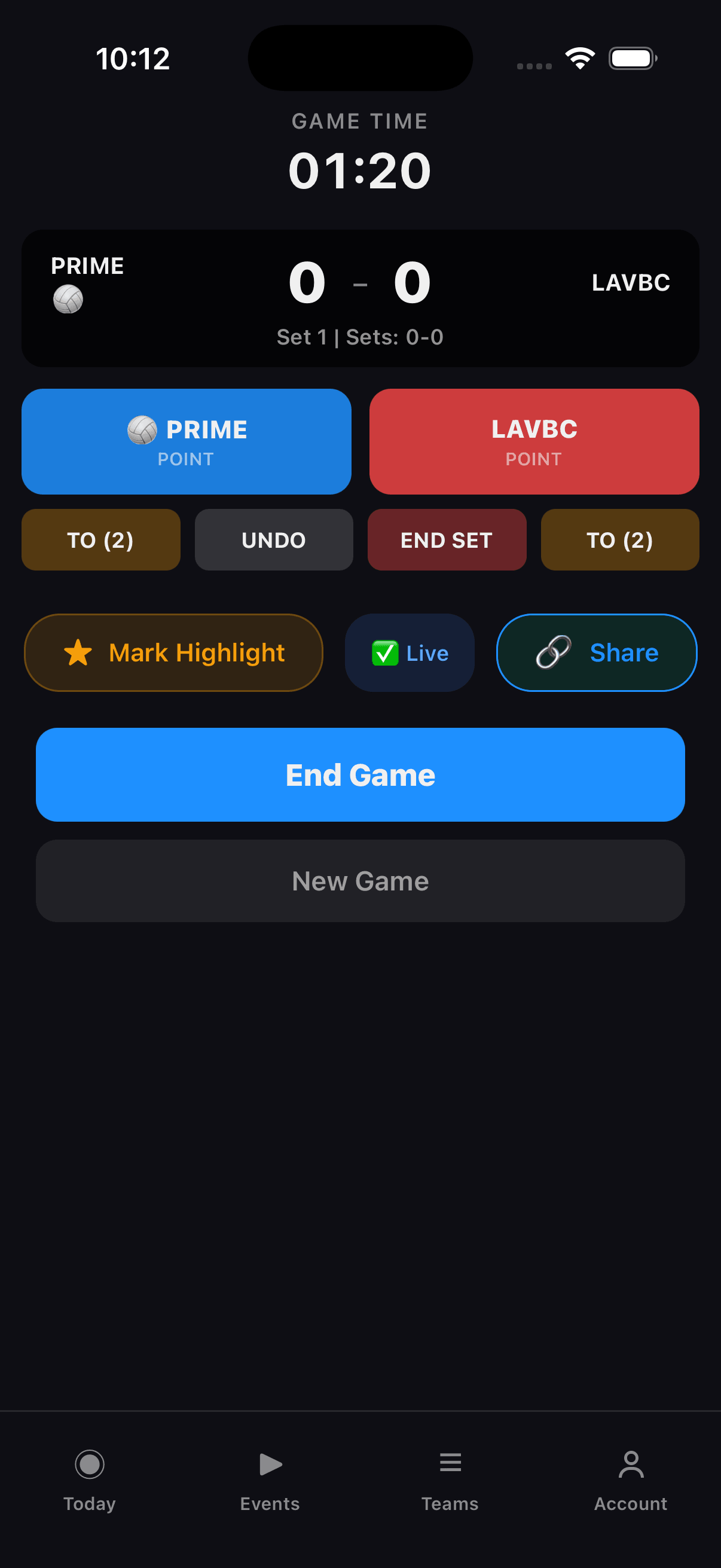
Once the match starts, your job settles into a rhythm. Here's the loop you'll repeat for every rally:
Step 1: Watch the Rally
Keep your eyes on the court. You don't need to understand every detail of the play — you just need to see it end. The ball hits the floor, goes out, or a whistle blows.
Step 2: Watch the Referee
This is the most important step. After every rally, the ref blows the whistle and extends one arm toward the team that won the point. That arm tells you everything you need to know. Right arm up = point to the team on the ref's right. Left arm up = point to the team on the ref's left.
Do not record the point until you see the ref's signal. Even if you're sure you know who won the rally, wait for the ref. They are the authority, and occasionally they see things you don't.
Step 3: Record the Point
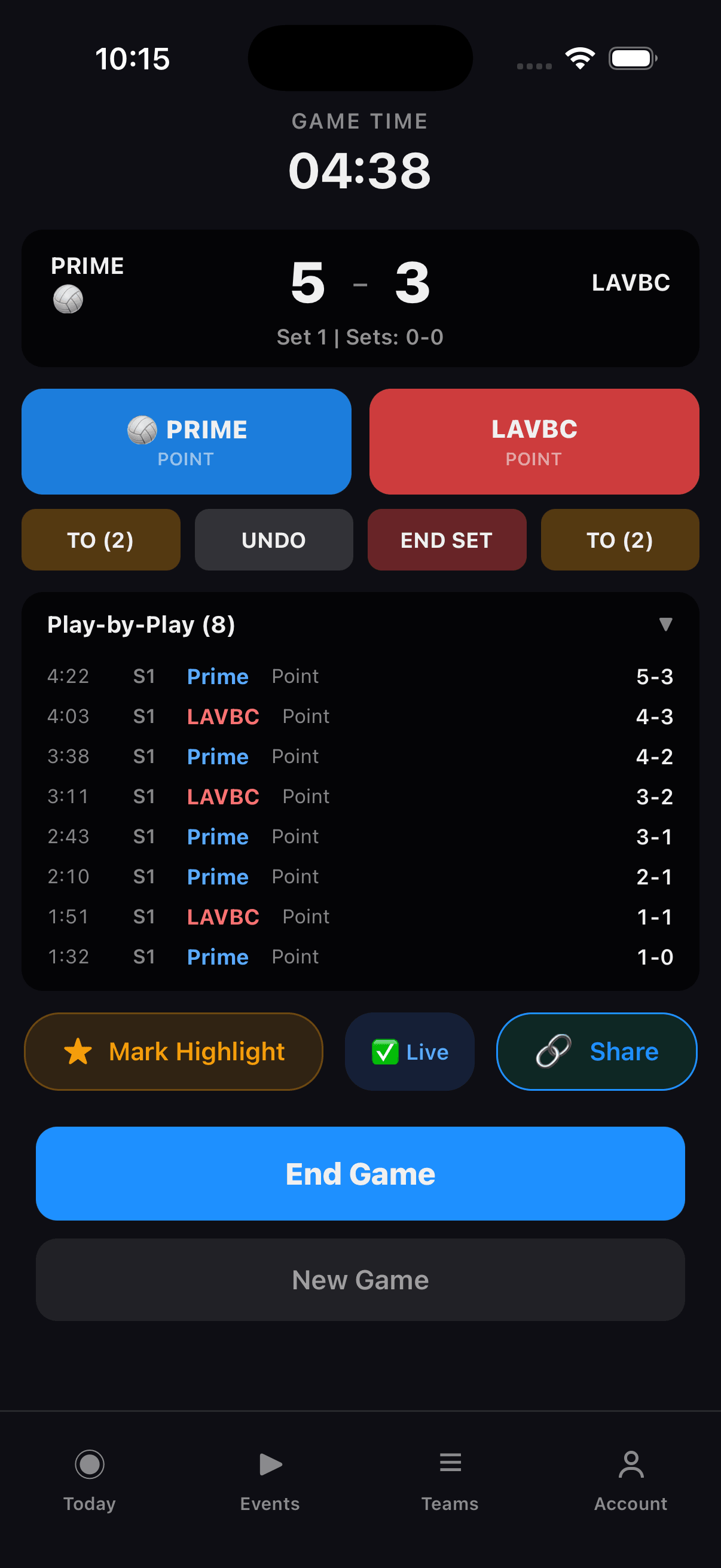
Add one point to the winning team's score. On a paper scoresheet, this usually means marking the next number in that team's column. In an app, tap the appropriate team's button.
Step 4: Note the Serving Team
After recording the point, quickly note who is serving next:
- If the serving team won the rally, the same server continues. No rotation.
- If the receiving team won the rally (a side-out), they gain the serve and must rotate one position clockwise before serving.
Step 5: Handle Timeouts and Substitutions
Between rallies, a coach may request a timeout or a substitution. The ref will signal these clearly. When they happen, record them:
- Timeout: Mark which team called it and at what score.
- Substitution: Note the players swapping (jersey numbers) and update your running count.
Then go back to Step 1 for the next rally. That's the entire loop.
Between Sets: The Reset
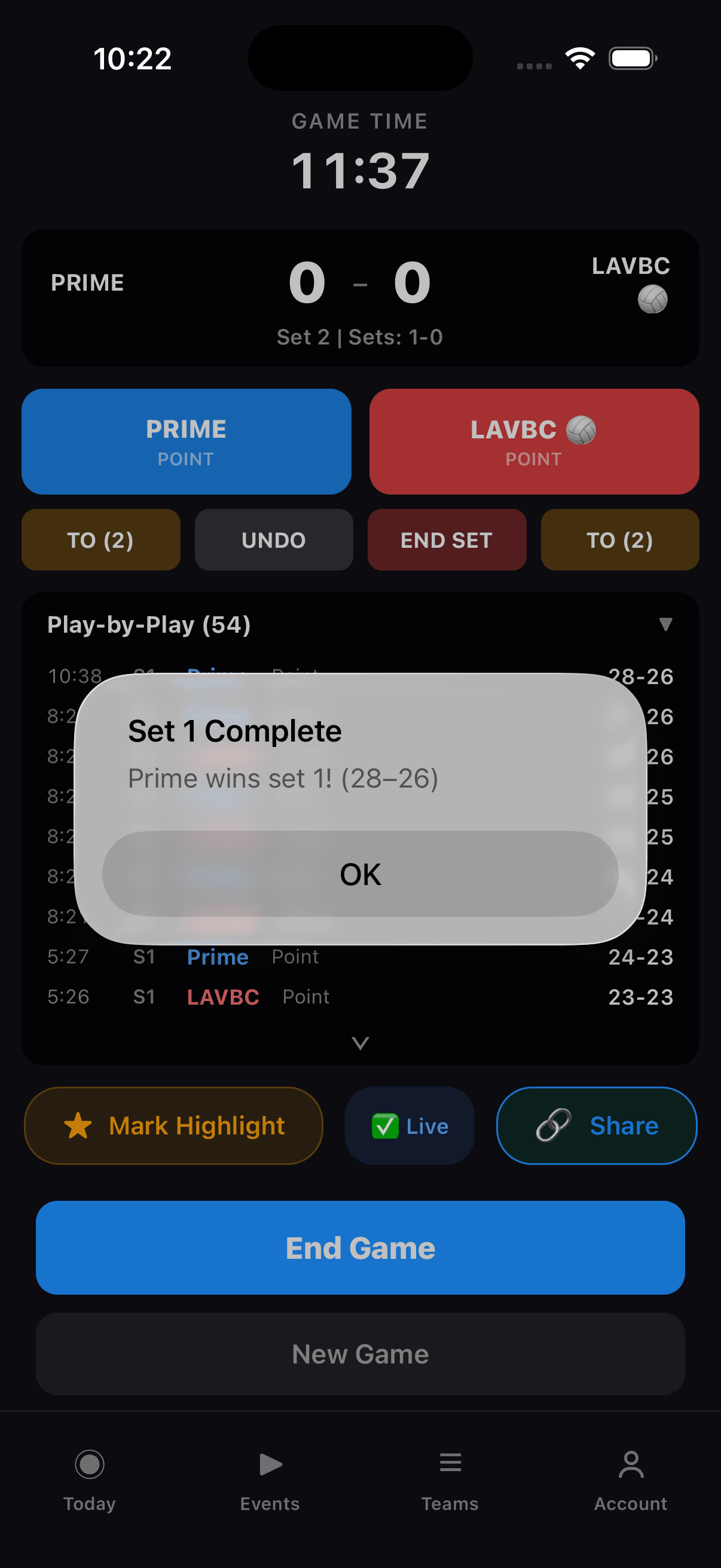
When a team reaches 25 points (15 in a deciding set) with a 2-point lead, the set is over. Here's your between-sets checklist:
- Record the final score of the set (e.g., "Set 1: Eagles 25, Hawks 21").
- Record which team won the set and update the match set count.
- Confirm with the ref — announce the final score and set count. The ref will nod or correct you.
- Reset for the next set — both teams start at 0-0 with fresh timeouts and substitutions.
- Note the first serve — the ref will indicate which team serves first in the new set (it alternates).
Take a breath. Between sets is your chance to review your scoresheet, make sure your running totals are correct, and get ready for the next set. Teams usually take 2-3 minutes between sets — use that time.
After the Match: Wrapping Up
When one team wins enough sets to clinch the match (2 in best of 3, or 3 in best of 5), the match is over. Your final duties:
- Record the final set score.
- Record the match result — team name, sets won (e.g., "Eagles win 2-1").
- Confirm the final result with the referee. This is important. The ref will review the scoresheet and sign it at formal events.
- Turn in the scoresheet to the league coordinator, ref, or whichever authority needs it.
If you're using an app, save the final result and share it with whoever needs it (coach, league admin, etc.).
When Things Go Wrong
Here are the most common "oh no" moments and how to handle them:
You missed a point. Ask the ref immediately. "Sorry, I missed that — which team?" They will tell you. No one will judge you for asking. They will judge you for guessing wrong and not correcting it.
Your count doesn't match the scoreboard. Stop and reconcile before the next serve. Count back through your marks. If you can identify where the discrepancy is, fix it. If you can't, the scoreboard operated by the ref or line judge takes precedence.
A coach disputes the score. Stay calm. Show your scoresheet. If there's a disagreement, the ref resolves it. Your job is to present your record clearly.
You're completely lost. It happens. Call a brief pause, explain to the ref that you've lost track, and ask them to confirm the current score, set count, and serving team. Reset from there. Better to take 30 seconds to get back on track than to silently record wrong data for the rest of the match.
For a detailed breakdown of the most common errors and how to prevent them, see Common Volleyball Scoring Mistakes.
Your Cheat Sheet
Keep these numbers in your head (or written at the top of your scoresheet):
- Sets to 25 (or 15 in the deciding set)
- Win by 2
- 2 timeouts per team per set
- Every rally = 1 point to someone
That's the entire framework. Everything else is details you can look up or ask about in the moment.
You're not expected to be perfect. You're expected to pay attention, record what happens, and ask when you're unsure. That's a scorekeeper. And if you're reading this guide beforehand, you're already more prepared than 90% of the volunteers who've sat in that chair before you.
For the complete rules reference, see our Complete Guide to Volleyball Scoring. And you've got this.
Ready to put this into practice?
Stathlon lets you score games, stream live video, and capture highlights — all from your phone. The scoring interface is designed so everything you just learned applies directly.
Continue Reading
Complete Guide to Volleyball Scoring
Everything you need to know about volleyball scoring — from rally scoring basics to win-by-two rules and set structure.
Rally Scoring Explained
How rally scoring works in volleyball, why it replaced side-out scoring, and what it means for scorekeepers.
Scorekeeping for Beginners — A Parent's Guide to Youth Sports
New to scorekeeping? A practical guide covering volleyball, flag football, and soccer. What to track, common mistakes, and how apps like Stathlon make it easier.