Flag Football Scoring Rules
How scoring works in flag football — touchdowns, extra point attempts, safeties, and the key differences from tackle football.
How Flag Football Scoring Differs from Tackle Football
If you know tackle football, you already know most of flag football scoring. The core is the same — teams move the ball down the field and score touchdowns. But there are a few key differences that matter for scorekeepers:
- No field goals. There's no kicking in flag football. No field goal attempts, no kickoffs, no punts. This simplifies scoring significantly.
- Extra points are plays, not kicks. After a touchdown, the scoring team runs a play from a set yardage line. They choose between a +1 attempt (shorter) or a +2 attempt (longer).
- No kicked PATs. The "extra point" in flag football is a conversion play, not a kicked ball through uprights.
Everything else — touchdowns, safeties, the 4-quarter structure — works the same way.
Point Values
| Scoring Play | Points | Notes |
|---|---|---|
| Touchdown (TD) | 6 | Ball crosses the goal line via run or catch |
| Extra Point (+1) | 1 | Conversion play from the short line (typically 5 yards) |
| Two-Point Conversion (+2) | 2 | Conversion play from the longer line (typically 10-12 yards) |
| Safety | 2 | Offense is flagged in their own end zone; points go to defense |
What's NOT in flag football
| Tackle Football Play | Flag Football? |
|---|---|
| Field Goal (3 pts) | Does not exist |
| Kicked PAT (1 pt) | Replaced by +1 conversion play |
| Kickoff | Replaced by spot-of-ball start |
| Punt | Some leagues allow, most don't |
Touchdowns (6 Points)
A touchdown works the same as in tackle football. The ball carrier crosses the opponent's goal line — either by running or receiving a pass — and the team is awarded 6 points.
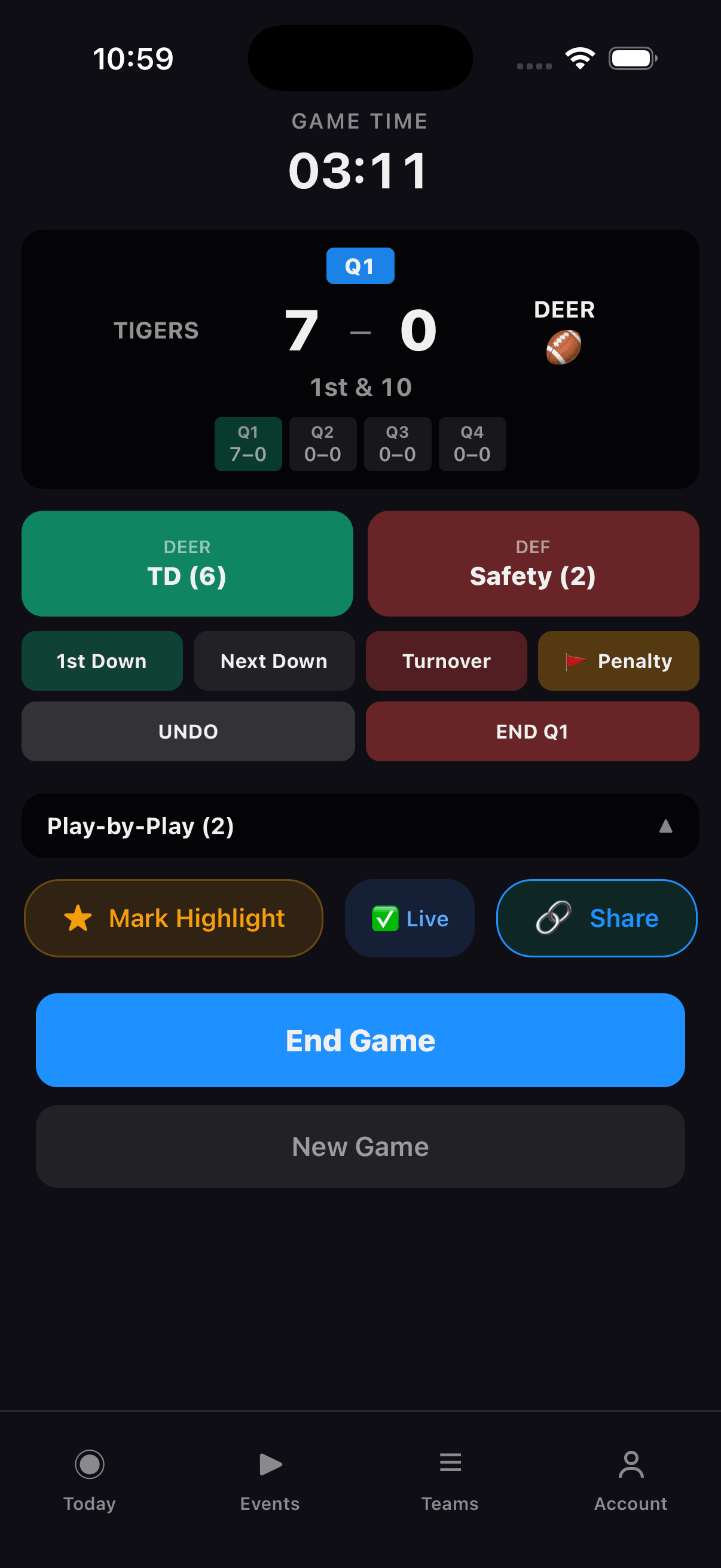
As a scorekeeper, record the TD and which team scored. In Stathlon, you tap the "TD (6)" button for the team with possession.
The Extra Point Decision: +1 or +2
This is the biggest scorekeeping moment unique to flag football. After every touchdown, the scoring team must choose:
- +1 Point (Extra Point): A conversion play from the short line (usually 5 yards from the goal line). Lower risk, lower reward.
- +2 Points (Two-Point Conversion): A conversion play from a longer distance (usually 10-12 yards). Higher risk, higher reward.
- No Good (Failed): If the play fails — incomplete pass, flag pull, interception — the attempt is worth 0 points. The scoring team keeps their 6 for the TD.
Why this matters for scorekeepers
In tackle football, the PAT kick is almost automatic (99%+ success rate in the NFL). In flag football, the conversion play can genuinely fail. You'll see failed attempts regularly, which means the score doesn't always go up by 7 after a touchdown. A scorekeeper needs to pay attention to:
- Did the team choose +1 or +2? — This determines the possible points
- Did the play succeed? — Record +1, +2, or 0 accordingly
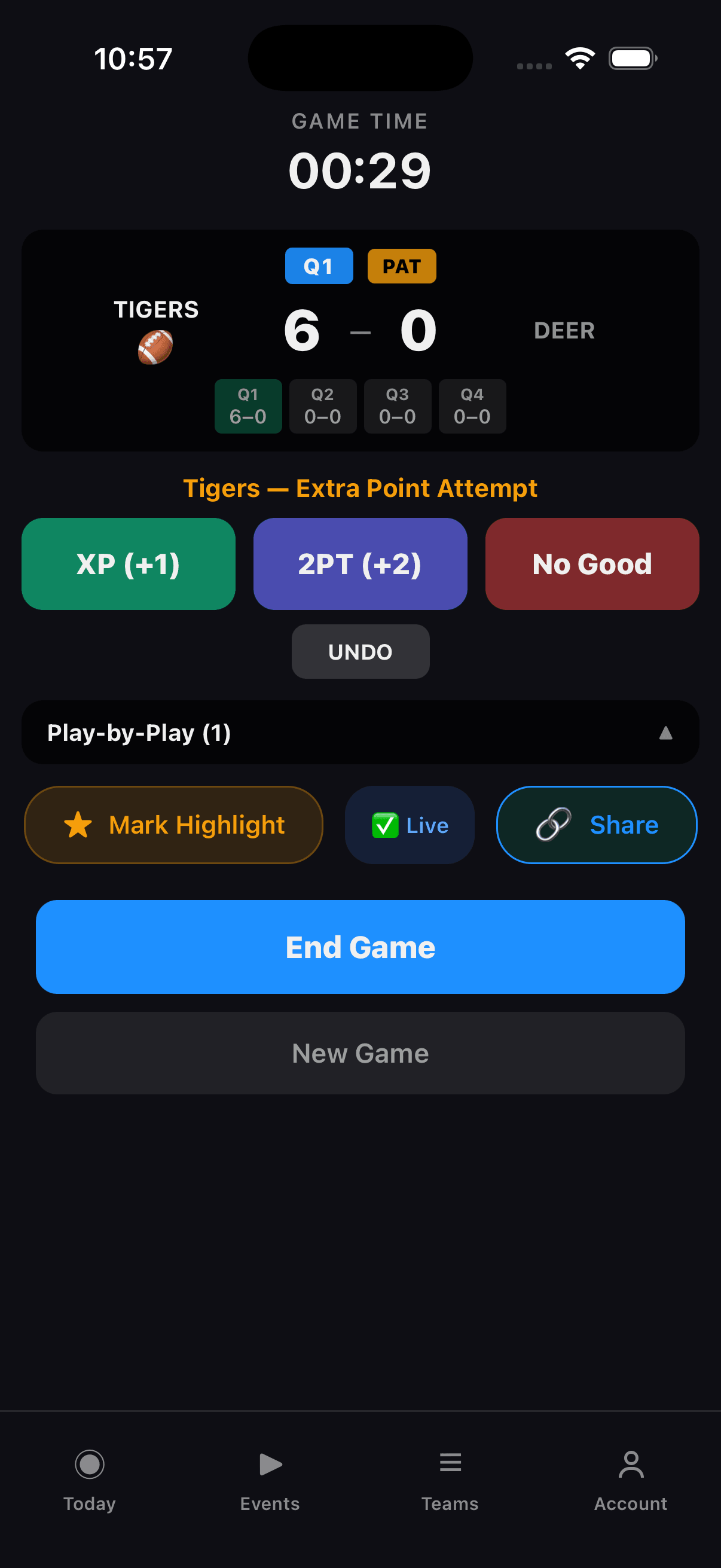
In Stathlon, after you record a touchdown, the app automatically prompts you with three buttons: XP (+1), 2PT (+2), or No Good. You can't advance to the next play until you record the result.
Safeties (2 Points)
A safety occurs when the offense is flagged (or loses the ball) in their own end zone. The defensive team gets 2 points.
Safeties are rare in flag football — even rarer than in tackle football — but they do happen. When one occurs, make sure you award the points to the defense, not the team that had the ball.
Game Structure
Most flag football leagues use a 4-quarter format, though the quarter length varies by league (often 8-12 minutes running clock, or shorter for youth). Some leagues use halves instead of quarters.
Key structural rules for scorekeepers:
- Timeouts: Typically 3 per team per half (reset at halftime)
- Possession after scores: Varies by league — some start from a set line, others alternate
- Overtime: League-dependent, often involves alternating possessions from a set yardage line
Your league will specify these details before the season. As a scorekeeper, the main thing is to track the score, the quarter, and timeouts.
Quick Reference for Scorekeepers
- Touchdown: +6, then immediately record the extra point attempt
- Extra Point options: +1 (short), +2 (long), or 0 (failed)
- Safety: +2 to the defensive team
- No field goals — if someone asks "is it 3 points?", the answer is always no
- Quarter tracking: Note the quarter on each scoring play
Common Mistakes
- Forgetting the PAT result. After a TD, the play isn't over — you still need to record +1, +2, or failed. Don't move on until you've captured it.
- Awarding a safety to the wrong team. Safeties give points to the defense. The team that caused the safety in their own end zone does NOT get the points.
- Looking for a field goal button. There isn't one in flag football. If a team is in scoring range but doesn't reach the end zone, the drive just ends with a turnover on downs.
Ready to put this into practice?
Stathlon lets you score flag football games with a tap — touchdowns, PAT choices, safeties, and full quarter tracking. All from your phone.
Continue Reading
Flag Football Player Stats — What to Track
A parent and coach's guide to tracking individual player stats in flag football. Learn which stats matter, how they're recorded, and how Stathlon automates the box score.
Flag Football Positions & Roles Explained
A beginner's guide to flag football positions — quarterback, receivers, center, rushers, and defenders. What each role does and how it affects scoring and stats.
How to Keep Score at a Flag Football Game
A practical, step-by-step guide for first-time flag football scorekeepers. Pre-game prep, during the game, the PAT moment, and what to do between quarters.