How to Score a Baseball Game: A Beginner's Guide
A practical guide for first-time baseball scorekeepers. What to track, how innings work, and how to record runs, hits, errors, and outs without getting lost.
Someone Handed You the Scorebook
Maybe your kid's coach looked at you and said, "Can you keep the book today?" Maybe you volunteered because nobody else would. Either way, you are now the official scorekeeper, and a lineup card full of tiny boxes is staring back at you. This guide will get you through the game.
What a Scorekeeper Actually Tracks
At its core, baseball scoring comes down to four things:
- Runs — how many times a player crosses home plate
- Hits — how many times a batter reaches base safely on a batted ball (no errors, no walks)
- Errors — how many times a fielder makes a mistake that lets a batter or runner advance
- Outs — how each batter's plate appearance ended (if they didn't reach base)
That is really it. Everything else — strikeouts, walks, stolen bases, double plays — is detail that fills in the story. But runs, hits, errors, and outs are the backbone.
How Innings Work
A standard youth baseball game is 6 innings (7 for older age groups, 9 in high school and above). Each inning has two halves:
- Top of the inning: the visiting team bats
- Bottom of the inning: the home team bats
Each half-inning ends when the batting team records three outs. An out can happen in several ways: a strikeout, a caught fly ball, a tag, or a force play at a base. As the scorekeeper, you mark how each out was made.
At the end of the game, you add up the runs scored in each inning. That gives you the final score.
The Linescore: Your Scoreboard on Paper
The linescore is the simplest part of your scorebook. It looks like this:
| 1 | 2 | 3 | 4 | 5 | 6 | R | H | E | |
|---|---|---|---|---|---|---|---|---|---|
| Visitors | 0 | 2 | 0 | 1 | 0 | 0 | 3 | 6 | 2 |
| Home | 1 | 0 | 0 | 0 | 3 | X | 4 | 5 | 1 |
Each numbered column is an inning. R is total runs, H is total hits, E is total errors. The X in the home team's last inning means they did not need to bat because they were already ahead.
Update this after every half-inning. It is your running summary of the entire game.
What to Record for Each Batter
When a batter comes to the plate, you are tracking one question: what happened? The result falls into one of a few categories:
- Hit — the batter reached base on a fair ball. Mark it as a single (1B), double (2B), triple (3B), or home run (HR).
- Walk (BB) — four balls, batter goes to first.
- Strikeout (K) — three strikes, batter is out.
- Groundout or flyout — use the defensive position numbers to show who made the play (e.g., 6-3 means the shortstop threw to the first baseman).
- Error (E) — the batter reached because a fielder made a mistake. Note which fielder (E5 = third baseman error).
If you are not sure what happened, write down what you saw and sort it out between innings. Nobody expects perfection on your first day.
Tracking Runs
A run scores when a player touches home plate. This is the most important thing you track — it determines who wins. When a run scores:
- Mark the run in that player's at-bat box
- Add it to the inning column in your linescore
- Credit the batter with an RBI (run batted in) if their hit or play drove the runner home
The Most Common Beginner Mistakes
Forgetting to count outs. Three outs end the half-inning. If you lose track, you might record an at-bat that happened in the next inning. Keep a tally.
Confusing hits and reaching base. A batter who reaches on an error did not get a hit. A walk is not a hit. Only a ball put in play that results in the batter reaching safely — without a fielder's mistake — counts as a hit.
Not updating the linescore between innings. Do it immediately when the third out is recorded, while the numbers are fresh.
Your First-Game Survival Kit
If this is your first time, focus on just three things:
- Track outs — count to three, then switch sides
- Track runs — who scored and when
- Update the linescore — runs per inning, running total
That is enough to produce an accurate final score. The detailed play-by-play scoring will come with practice. Give yourself a few games, and the symbols and shorthand will start to feel natural.
For a complete reference of scoring abbreviations and position numbers, see our Baseball Scoring Glossary.
Make It Easier with Stathlon
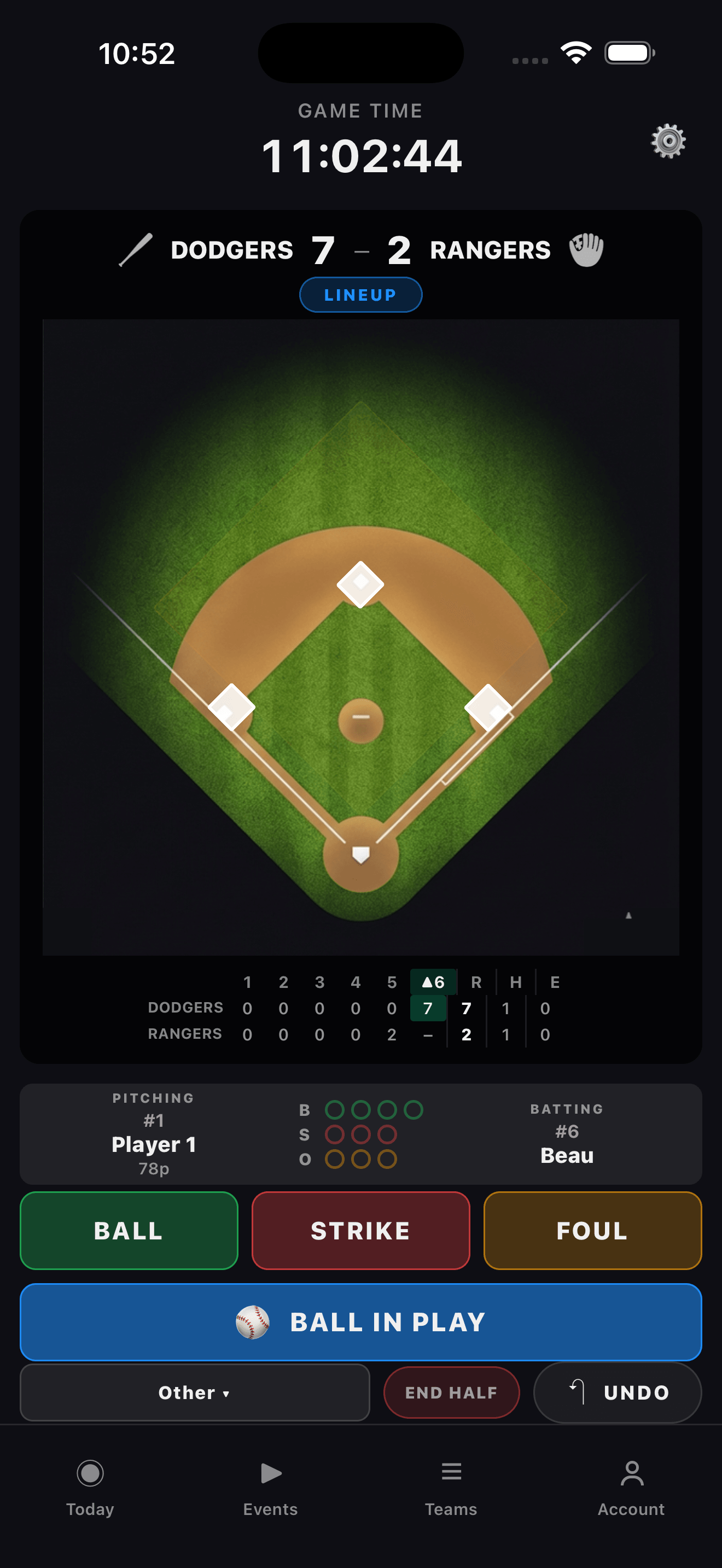
Paper scorebooks work, but they require you to do the math yourself and reconstruct the game afterward. Stathlon handles the bookkeeping for you — tap the play as it happens, and the app tracks runs, hits, errors, pitch counts, and the box score in real time. It is built for exactly this situation: a parent in the bleachers who wants to keep score without a statistics degree.
Ready to put this into practice?
Stathlon lets you score flag football games with a tap — touchdowns, PAT choices, safeties, and full quarter tracking. All from your phone.
Continue Reading
Baseball Scoring Glossary: Stats, Abbreviations & How to Read a Box Score
A comprehensive glossary of baseball scoring abbreviations, defensive position numbers, batting and pitching stats, and how to read a box score. Written for youth sports parents new to scorekeeping.
The 7 Ways to Get on Base in Baseball
There are exactly 7 ways a batter can reach base in baseball. Most fans only know 2 or 3. Here's the complete list, from the obvious to the obscure.
Understanding Baseball Pitch Counts and Rest Rules
A parent-friendly guide to Little League pitch count limits by age, mandatory rest days, and why these rules exist. Includes the official thresholds for ages 6-16.